
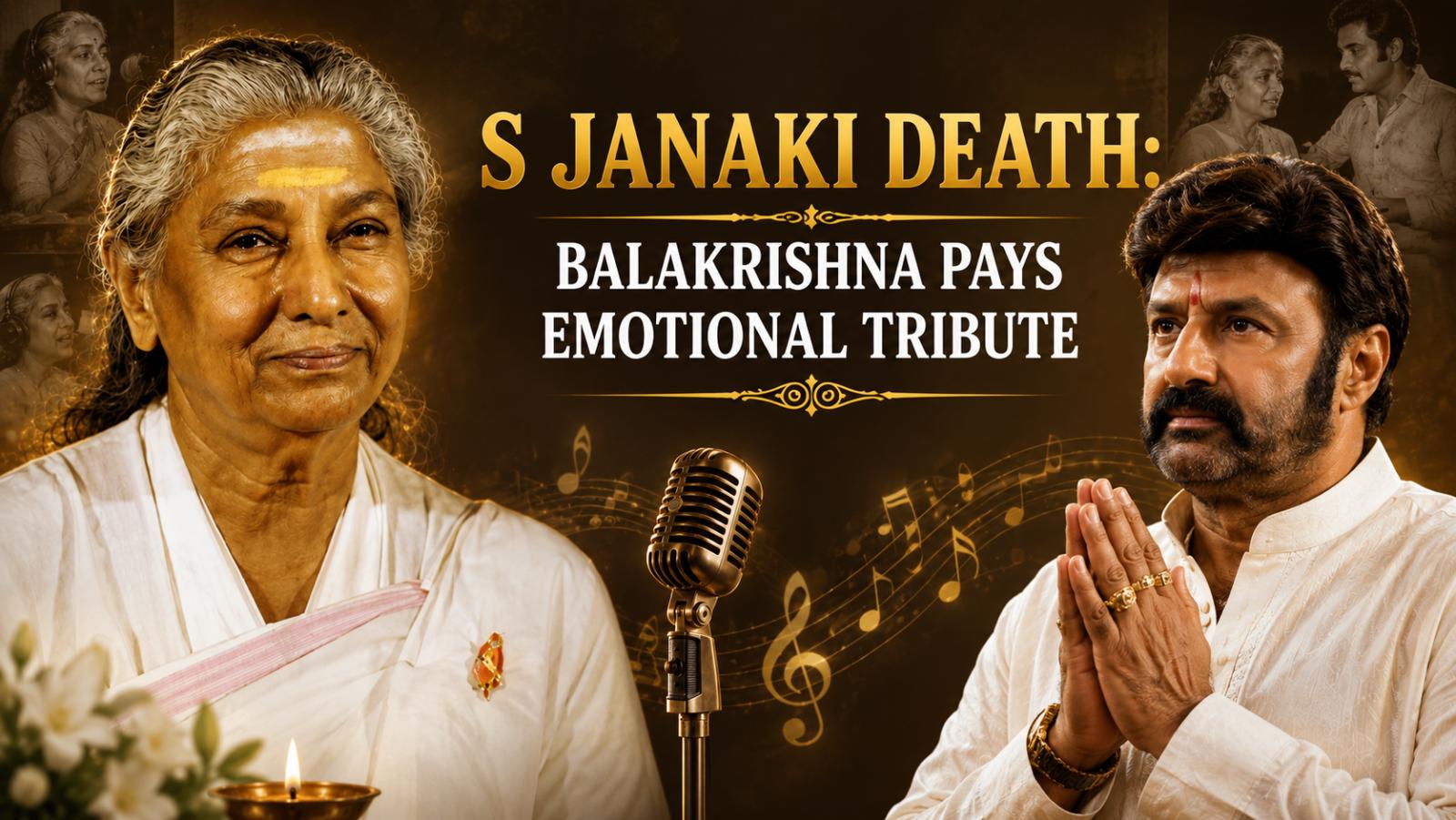
Legendary playback singer S. Janaki’s death has left the Indian film and music industries in mourning, with actor Nandamuri Balakrishna remembering her timeless voice, unforgettable songs and decades-long relationship with the Nandamuri family.
Balakrishna Mourns the Loss of S. Janaki
Nandamuri Balakrishna expressed deep shock and sorrow over the death of legendary playback singer S. Janaki, describing her passing as an irreparable loss to Indian cinema. Janaki, widely celebrated as the “Nightingale of South India,” died at the age of 88 in Mysuru on July 11, 2026. Her family confirmed that she passed away peacefully while surrounded by loved ones. In his condolence message, Balakrishna said the news had left him profoundly disturbed because Janaki Amma was not merely a playback singer but a cultural presence whose voice accompanied generations of listeners through love, joy, grief, devotion and hope. He recalled how her melodious singing entertained millions of music lovers for several decades and noted that the void created by her death could never truly be filled. Balakrishna’s tribute reflected the emotions of countless admirers who grew up listening to her songs on radio, records, television and in cinema halls. Her ability to express a scene’s emotion through subtle changes in tone made her voice instantly recognisable across languages. Balakrishna prayed for eternal peace for her soul and conveyed his heartfelt condolences to her family members, close associates and millions of fans. His words carried both personal grief and the wider sorrow of the Telugu film industry, which regarded Janaki as one of its most precious and enduring musical voices.
A Decades-Long Bond With the Nandamuri Family
A deeply personal element in Balakrishna’s statement was his recollection of S. Janaki’s long association with the Nandamuri family. He said she had sung many memorable and evergreen numbers in the films of his father, the late Nandamuri Taraka Rama Rao, and had also lent her voice to several songs featured in his own films. According to Balakrishna, those compositions would continue to be loved because Janaki’s singing gave them an emotional life that extended far beyond the films for which they were originally recorded. Her voice became closely connected with the screen images, performances and stories that shaped popular Telugu cinema across different decades. Balakrishna also emphasised that Janaki shared a warm relationship with his family for many years, making her death feel like a personal loss rather than only the passing of a respected industry colleague. In Indian cinema, an unforgettable playback voice can become inseparable from an actor’s screen presence. Janaki excelled in that relationship. She could sound playful in a romantic sequence, intense in a dramatic moment, tender in a lullaby and spiritually uplifting in a devotional song. That extraordinary range helped her songs remain relevant even as musical styles, recording technology and audience tastes changed. For the Nandamuri family, her contribution formed part of a larger cinematic legacy connected with NTR’s historic career and Balakrishna’s journey as a leading Telugu actor. By remembering that shared history, Balakrishna underlined how Janaki’s work was woven into the personal and professional memories of film families as well as the collective memory of audiences.
The Extraordinary Musical Journey of Janaki Amma
S. Janaki’s career was remarkable not only for its duration but also for its scale, linguistic range and artistic versatility. Born on April 23, 1938, in Pallapatla in present-day Andhra Pradesh, she began her playback career in the late 1950s and went on to sing for more than six decades. Reports credit her with recording over 48,000 songs across about 20 Indian languages, with an especially vast body of work in Telugu, Tamil, Kannada and Malayalam. She also sang in Hindi, Odia, Tulu, Urdu, Punjabi and Bengali, among other languages, allowing her voice to become familiar across regions and generations. Her career included collaborations with some of Indian cinema’s most celebrated composers, lyricists and male playback singers, including S. P. Balasubrahmanyam, P. B. Srinivas and Dr Rajkumar. Janaki received four National Film Awards and numerous state honours, recognition that reflected both her technical excellence and emotional depth. Yet statistics alone cannot explain her influence. What distinguished Janaki was her rare capacity to inhabit a song completely. She altered pronunciation, expression, vocal texture and emotional intensity according to the language and dramatic requirement, often making listeners feel that the song had been written specifically for her voice. She could move effortlessly from folk-inspired energy to classical nuance, from childlike innocence to mature sorrow, and from light comedy to profound devotion. This adaptability made her a favourite across multiple film industries and earned her affectionate titles such as Janaki Amma and Gaana Kogile. Her songs crossed generations and continued to influence singers who admired her control, phrasing and emotional honesty.
An Immortal Voice That Will Continue to Inspire
Balakrishna’s final prayer for S. Janaki’s soul captured the central feeling behind the tributes that followed her death: a great artist may leave the world, but the emotional life of her work continues. For millions of listeners, Janaki’s songs are connected with deeply personal memories—childhood mornings, family gatherings, festival celebrations, long journeys, moments of heartbreak and scenes from beloved films. That intimate relationship explains why her death caused grief far beyond the film fraternity. Leading actors, singers, political figures and admirers across India remembered her not only for her awards and vast discography but also for the humility and warmth associated with her public life. Her granddaughter’s message described her as a loving family figure whose kindness and grace were as meaningful to those close to her as her iconic voice was to the world. Balakrishna’s tribute similarly balanced public admiration with private affection. By recalling her songs for NTR and for his own films, he reminded audiences that cinema history is preserved not only through images and performances but also through voices that give those images emotional permanence. Janaki’s passing marks the end of an extraordinary chapter in Indian playback singing, yet her artistic presence remains secure. Her recordings will continue to introduce new audiences to the richness of South Indian film music, while established listeners will return to them for comfort and nostalgia. The singer who gave expression to countless screen emotions has left behind a legacy that cannot be measured only in numbers. Her voice will remain alive wherever her songs are played, remembered and passed from one generation to the next. Om Shanti.