
Thematic Funds at a Glance
Thematic mutual funds can capture long-term trends such as manufacturing, data centres, healthcare, and consumption, but they carry concentration and timing risks. Investors should study valuations, portfolio overlap, and exit plans before making a limited allocation.
7 Thematic Mutual Fund Themes for Long-Term Growth
Thematic mutual fund themes for long-term growth are attracting investors seeking exposure to structural changes in India’s economy. Defence production, manufacturing, digital infrastructure, healthcare, and rising consumption are among the areas receiving greater attention.
However, thematic funds should not be selected only because they delivered strong returns in the recent past. Investors must understand the theme’s business cycle, current valuations, portfolio composition and possible exit strategy before committing money.
Unlike a diversified equity fund, a thematic scheme concentrates its investments around a particular economic trend. This concentration can produce strong gains when the theme performs well, but it can also cause significant corrections when the investment cycle turns.
What Are Thematic Mutual Funds?
A thematic mutual fund invests in businesses connected to a broad investment idea. The companies may operate in different industries, but benefit from the same underlying trend.
For example, a data-centre theme may include data-centre operators as well as cable manufacturers, cooling-system providers, battery companies, transformer makers, water-management businesses and engineering contractors.
A sectoral fund, in comparison, is generally concentrated in one industry, such as banking, technology, or pharmaceuticals. AMFI explains that thematic funds can spread investments across industries connected to a common theme, although they remain more concentrated than broadly diversified equity schemes.
Thematic Mutual Fund Themes for Long-Term Growth
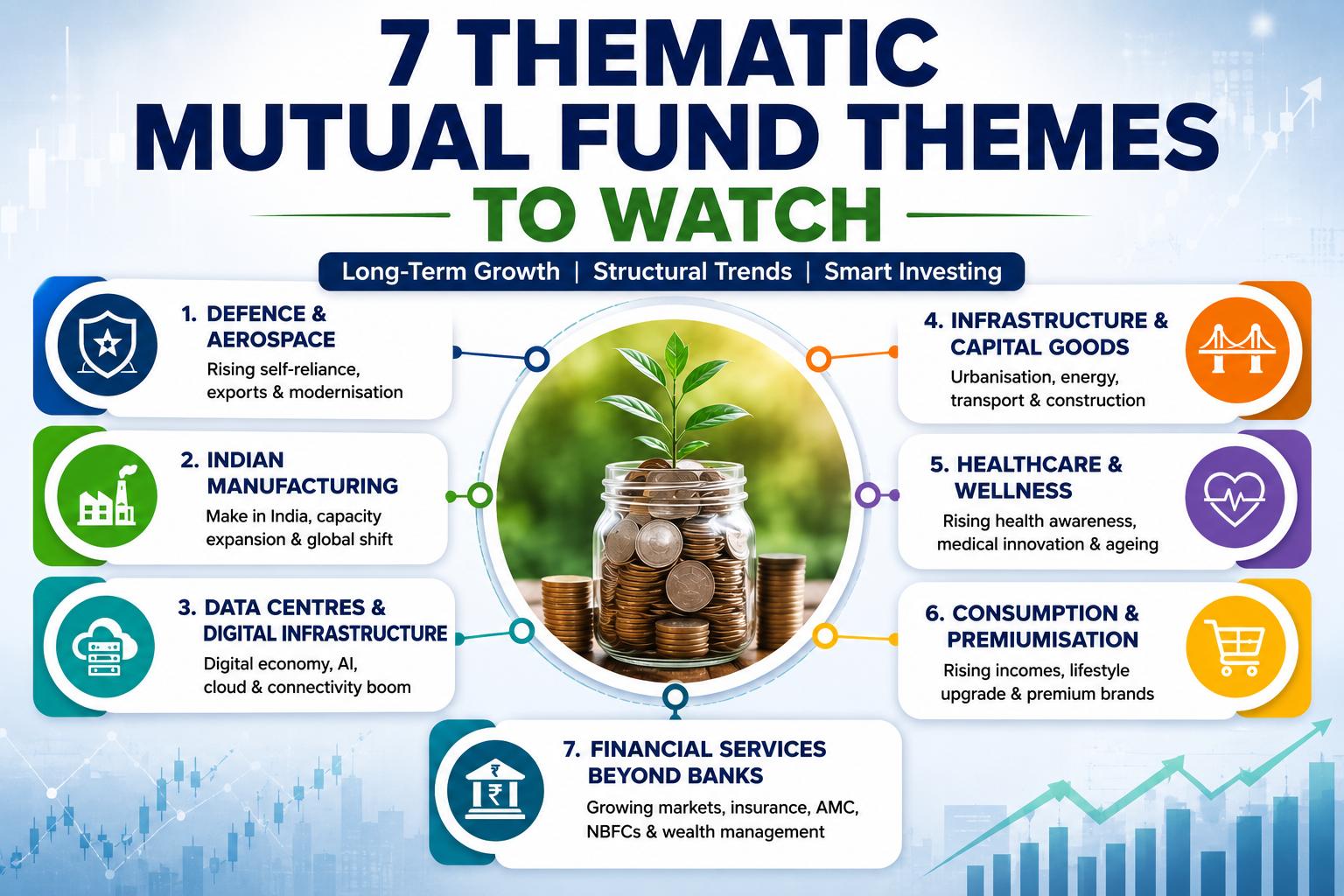
1. Defence and Aerospace
India’s defence sector may benefit from higher domestic production, export opportunities, and the government’s focus on reducing dependence on imported equipment.
The theme can include aircraft manufacturers, defence-electronics companies, missile-system suppliers, shipbuilders, and specialised engineering businesses.
The main concern is valuation. Several defence-related companies may already be pricing in a substantial portion of their expected growth. Investors entering after a sharp rally could face prolonged periods of weak or negative returns.
A staggered investment approach may reduce timing risk, but it cannot eliminate the possibility of a correction.
2. Indian Manufacturing
Manufacturing is one of the broadest long-term investment themes. It may include industrial equipment, capital goods, electronics, defence manufacturing, infrastructure suppliers, and businesses benefiting from new production facilities.
Investors should examine how each fund defines manufacturing. Some schemes may include banks because they finance industrial expansion, while others may focus almost entirely on companies directly involved in production.
The theme’s success will depend on new private investment, capacity expansion, export competitiveness, and whether manufacturing increases its contribution to India’s economy.
3. Data Centres and Digital Infrastructure
The growth of cloud computing, artificial intelligence, and digital services is increasing demand for data-centre capacity.
The investment opportunity extends beyond companies that own or operate data centres. It may include high-density cable producers, cooling companies, electrical-equipment manufacturers, battery suppliers, water-treatment businesses, and engineering contractors.
This wider ecosystem makes data centres a thematic opportunity rather than a single-sector investment. Nevertheless, investors should examine whether projected growth is already reflected in company valuations.
4. Infrastructure and Capital Goods
Infrastructure funds can provide exposure to power, transport, energy, construction, engineering, and capital-goods companies.
Different schemes may follow very different strategies. One fund may hold banks and financial companies that provide infrastructure financing, while another may concentrate on power producers, engineering companies, and equipment manufacturers.
Investors should check the scheme’s sector allocation rather than relying only on the word “infrastructure” in its name.
5. Healthcare and Wellness
Healthcare is developing into a broader theme that includes hospitals, diagnostics, pharmaceuticals, medical services, and preventive wellness.
Demand may be supported by changing lifestyles, greater health awareness, rising incomes, and the need for quality medical services.
The theme can offer long-term potential, but investors should still evaluate regulatory risks, company-specific valuations, and the fund’s dependence on a small number of healthcare segments.
6. Consumption and Premiumisation
India’s consumption theme covers fast-moving consumer goods, retail, consumer discretionary businesses, e-commerce, and premium products.
Rising household incomes and changing spending patterns may support companies selling higher-value products and services. Premiumisation—where customers shift toward more expensive or feature-rich products—has also emerged as an important sub-theme.
However, the category is not uniformly valued. Traditional consumer companies, online businesses, and discretionary brands may trade at significantly different valuations.
7. Financial Services Beyond BanksThe financial-services theme is wider than traditional banking. It can include asset-management companies, insurers, wealth managers, non-banking financial companies, distributors, and financial-index providers.
Growing participation in capital markets, insurance, and organised financial products may support these businesses over the long term.
Investors should check whether a financial-services fund is genuinely diversified or heavily dependent on banks and lending companies.
How Much Should Investors Allocate?
Thematic funds are generally more suitable as a supporting allocation than as the foundation of a portfolio.
Conservative investors who are uncomfortable with sharp fluctuations may prefer diversified funds. Investors with moderate risk tolerance could consider only limited exposure, while aggressive investors may allocate a somewhat higher proportion after reviewing their existing equity holdings.
Experts quoted in the original report suggested that moderate-risk investors could restrict thematic exposure to around 5% of their portfolio. Aggressive investors could consider approximately 10% to 15% of their equity allocation, while limiting exposure to any single theme. These figures are broad expert guidelines, not universal recommendations.
Check for Portfolio Overlap
Before adding a thematic fund, investors should review their existing mutual fund holdings.
Flexi-cap, large-cap, and large-and-mid-cap schemes may already own companies connected to defence, infrastructure, financial services, or manufacturing. Adding another focused fund could unintentionally increase exposure to the same stocks.
Investors should compare the scheme’s top holdings, sector allocation, and investment style with the rest of their portfolio.
Avoid Chasing Past Returns
A theme that produced exceptional returns in the previous year may already be expensive. Entering after valuations have reached extreme levels can increase the risk of steep drawdowns.
SEBI requires mutual fund schemes to display a Riskometer ranging from low to very high risk. Investors should review this indicator along with the scheme information document, portfolio concentration, expense ratio, and exit load before investing.
Thematic mutual funds can contribute to long-term wealth creation when the selected trend has a sustainable growth runway. However, disciplined allocation, valuation awareness and periodic portfolio reviews are more important than following whichever theme is currently popular.
Disclaimer: Mutual fund investments are subject to market risks. This article is for educational purposes and does not constitute investment advice. Investors should read all scheme-related documents and consult a qualified financial adviser before investing.