
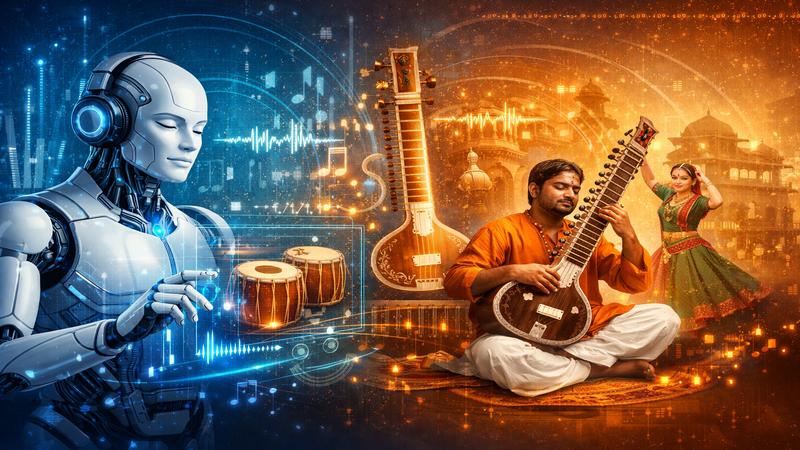
In recent years, artificial intelligence (AI) has emerged as a transformative force across various industries, from healthcare to finance. However, its impact has been equally profound in the world of music, especially in the realm of traditional Indian music. The convergence of AI with the rich and diverse tapestry of Indian musical traditions has created exciting possibilities for innovation, preservation, and evolution. Let’s explore the fascinating link between AI and traditional Indian music innovation.
AI: A New Companion for Traditional Indian Music
Traditional Indian music, with its centuries-old history, is known for its intricate ragas, talas, and unique improvisational styles. These elements form the foundation of classical music in both Hindustani and Carnatic traditions. However, as music continues to evolve and the demand for modern tools and techniques rises, AI is increasingly being integrated into the music industry, creating a bridge between ancient practices and contemporary technology.
AI’s role in traditional Indian music innovation can be explored through several lenses, including music composition, performance, education, and preservation.
AI in Music Composition and Arrangement
AI can significantly assist in the composition and arrangement of traditional Indian music by analyzing vast amounts of historical musical data. By understanding patterns within ragas and talas, AI models can generate new compositions that respect the fundamental principles of Indian classical music. AI can suggest modifications to existing compositions or create entirely new pieces by blending traditional elements with modern concepts.
For instance, AI systems are trained to recognize the mood, tempo, and intricacies of various ragas, and they can generate compositions that align with these structures. This allows musicians to explore new creative possibilities while staying true to the essence of traditional Indian music.
AI for Performance and Improvisation
Improvisation is a cornerstone of traditional Indian music, particularly in forms such as Hindustani classical and Carnatic music. AI can play a vital role in aiding musicians in the improvisational process. By using AI-driven tools, musicians can practice with virtual accompaniments, where the AI intelligently adapts to the performer’s playing style and improvisations. For example, AI can simulate an tabla player or a tanpura, responding in real-time to the artist's nuances.
Moreover, AI has been used to create “smart” instruments, such as tabla machines or sitar synthesizers, which offer new ways to interact with traditional instruments. These innovations allow musicians to explore sound design and experiment with fusion genres, combining traditional Indian instruments with modern electronic elements.
AI in Music Education and Learning
One of the most exciting applications of AI in traditional Indian music is in the field of education. AI-powered tools can serve as personal tutors, providing learners with feedback on their technique, timing, and intonation. This can be especially beneficial for students learning complex aspects of Indian classical music, which requires years of disciplined practice.
For example, AI can help beginners and intermediate students learn to identify and understand ragas, talas, and improvisational elements. AI systems can also suggest exercises for vocalists and instrumentalists to improve their skills, offering detailed analyses based on the user’s performance. This personalized learning approach, coupled with a database of classical music knowledge, ensures that the essence of Indian music is passed down through generations, without the barriers of limited access to traditional teachers.
Preserving the Richness of Indian Music
One of the greatest benefits of AI in traditional Indian music lies in its potential for preservation. India’s rich musical heritage spans thousands of years, and with a vast number of compositions passed down orally, there is a growing concern about the preservation of these traditions in the digital age. AI-driven technologies can play a pivotal role in preserving and cataloging India’s classical music heritage by creating digital archives.
By digitizing compositions, ragas, and performances, AI systems can help safeguard traditional Indian music for future generations. Furthermore, AI can assist in transcribing complex compositions into accessible formats, making them easier to share and study. This can lead to a deeper understanding of the music and its evolution over time.
Fusion of AI with Traditional Indian Music
The fusion of AI with traditional Indian music is opening up new doors for creativity and global collaboration. Indian classical music, with its deep emotional connection and intricate melodies, has a vast potential to be merged with other genres, thanks to AI’s adaptability. AI tools can help musicians fuse traditional Indian instruments with jazz, electronic music, or even western classical music, creating a unique cross-cultural sound.
For example, AI has been used to mix classical Indian music with electronic beats, generating new genres like Indian electronic fusion. By analyzing traditional rhythms and harmonies, AI can generate electronic tracks that respect the traditional style while introducing fresh, innovative elements.
The Future of AI and Traditional Indian Music
The collaboration between AI and traditional Indian music is still in its infancy, but it holds tremendous potential for the future. As AI continues to evolve, we can expect more sophisticated tools to emerge, helping musicians experiment with complex compositions, push the boundaries of improvisation, and continue preserving this invaluable cultural heritage.
AI is not about replacing the role of musicians or the rich tradition of Indian music but rather enhancing it, providing new ways for artists to innovate, learn, and express themselves. By blending the ancient with the modern, AI and traditional Indian music are creating a beautiful synergy that promises a bright future for both art forms.
The fusion of AI and traditional Indian music offers exciting opportunities for musicians and music enthusiasts alike. Through composition, performance, education, and preservation, AI is contributing to the evolution of this ancient art form. By embracing technology, we are ensuring that traditional Indian music continues to thrive in an ever-changing world.