

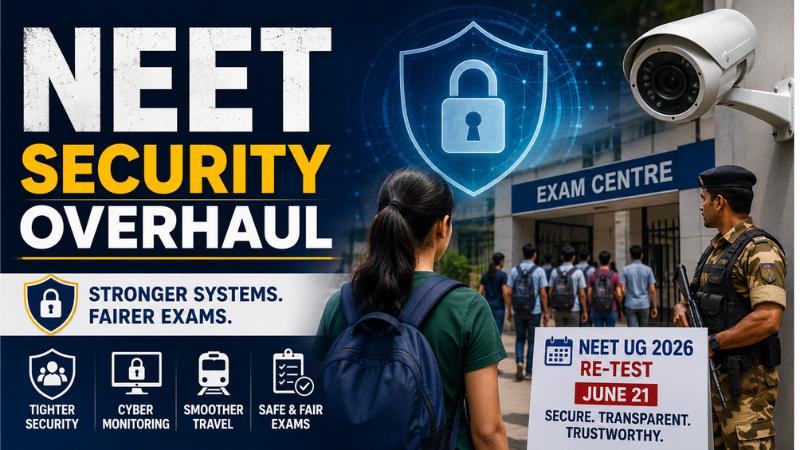
NEET UG 2026 Re-Test: Telegram Curbs, Cyber Watch And Central Forces Tighten Exam Security
The NEET UG 2026 re-test, scheduled for June 21, has been placed under a multi-layered security framework as authorities move to prevent paper leak rumours, fake online claims, and logistical disruptions during one of India’s biggest entrance examinations.
For lakhs of medical aspirants, the re-test has become not only an examination challenge but also a test of confidence in India’s entrance exam security system.
The security push comes after the earlier NEET UG 2026 examination held on May 3 was cancelled following alleged “guess paper” leak concerns, with a CBI probe ordered into the matter. In the run-up to the re-examination, central forces, cyber agencies, local police, railway authorities, and digital monitoring teams have been brought into a coordinated national plan.
Central Forces To Guard Exam Process
Officials have put in place strict physical security measures for the movement of question papers and answer booklets. Escort vehicles will accompany local police teams transporting exam material from distribution points to examination centres.
Central security agencies, including the CRPF and CISF, have also been placed on alert to assist with surveillance and safety arrangements at exam centres. The focus is to maintain a tamper-proof chain of custody from storage hubs to exam halls.
Authorities say the arrangement is aimed at ensuring that the exam process remains secure, uninterrupted, and fair for candidates across the country.
Telegram Restricted Ahead Of Re-Test
As part of the wider crackdown, the government has temporarily restricted access to Telegram in India until June 22, covering the exam day and its immediate aftermath. Telegram’s message-editing feature for already-posted messages has also been disabled in India until June 30.
The National Testing Agency said the move became necessary after several Telegram channels allegedly circulated claims of leaked question papers, edited screenshots, and fake promises of access to exam material. Some channels reportedly demanded payments from students and families by claiming they had access to NEET papers.
NTA has strongly denied that any question paper is available outside the secured examination system and warned students not to fall for fake paper leak offers.
Why Telegram Came Under Scrutiny
Telegram has been under the scanner because of its large public channels, anonymous usernames, file-sharing capacity and message-editing tools. According to officials, these features were allegedly misused by fraud networks to create fake “proof” of paper leaks.
One concern raised by NTA was that channel administrators could post a normal message before an exam and later edit it after the test to insert actual question-paper details or PDF files. Screenshots of such edited posts could then be circulated as false evidence that the paper had been leaked earlier.
Cyber agencies, including the Indian Cyber Crime Coordination Centre, have been monitoring online platforms, social media posts, suspicious channels, and digital misinformation linked to the NEET re-test. Several groups, channels, and bots allegedly involved in spreading fake claims have also faced takedown action.
Railways Brought Into Security Plan
A dedicated railway control room has also been set up to help students travelling to exam centres. Officials said transport coordination is important because lakhs of candidates may travel across cities and states for the re-test.
The railway coordination is expected to help prevent delays, monitor crowd movement, and ensure smoother travel support for candidates on exam day.
Debate Over Platform Ban
While authorities have defended the Telegram restriction as a temporary and exam-specific step, cybersecurity researcher Nisarga Adhikary has questioned whether blocking a platform can stop paper leaks. He argued that platform-level bans do not fix the deeper vulnerabilities that allow leaks or fake leak claims to spread.
Adhikary also pointed out that Telegram restrictions can be bypassed through proxies and other tools, making a complete shutdown difficult to enforce. According to him, the focus should be on strengthening exam security systems, identifying leak sources, and addressing institutional weaknesses.
Why WhatsApp Was Not Restricted
The Telegram action has also triggered questions over why WhatsApp has not faced similar restrictions. The key difference, according to the current explanation, lies in platform design and usage patterns.
Telegram allows large public channels, anonymous identities, large file sharing, and longer message editing flexibility. WhatsApp, meanwhile, has default end-to-end encryption, more limited message-editing features, and stronger account-based moderation systems for misuse patterns. This may be why officials viewed Telegram as a bigger risk in the specific NEET re-test context.
Students Urged To Trust Official Updates
With the NEET UG 2026 re-test approaching, NTA has urged students to ignore rumours, avoid fake websites, and report anyone claiming to sell question papers or posing as an official source. Candidates should rely only on official NTA updates and avoid unverified messages circulating on social media or messaging apps.
The larger message from authorities is clear: the re-test will be held under tighter security, stronger cyber monitoring, and coordinated transport support. At the same time, the debate around Telegram shows that India’s examination security challenge is no longer limited to exam halls. It now includes digital misinformation, cyber fraud, and the need for stronger systems that protect students from both real leaks and fake leak scams.