

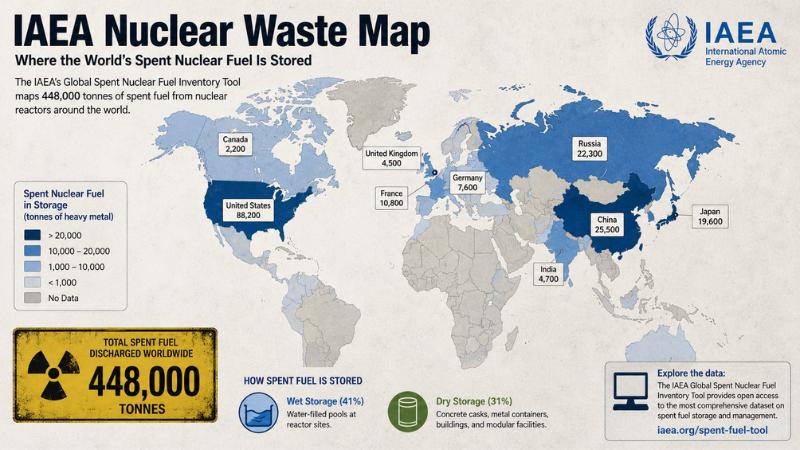
IAEA Map Reveals Where World’s Nuclear Waste Is Stored
The International Atomic Energy Agency has released a new interactive tool showing where the world’s spent nuclear fuel is stored, offering one of the clearest public views yet of the global nuclear waste challenge.
According to the IAEA, nuclear power plants worldwide have produced around 448,000 tonnes of spent nuclear fuel, equal to nearly 494,000 U.S. tons. The new Global Spent Nuclear Fuel Inventory Tool allows users to explore how different countries store, manage, and reprocess used nuclear fuel.
What The New IAEA Tool Shows
The tool brings together data submitted by countries under the Joint Convention on the Safety of Spent Fuel Management and on the Safety of Radioactive Waste Management.
Instead of depending on scattered estimates, the platform provides a more standardized picture of global spent fuel inventories. Users can check spent fuel information by country, region, and storage method.
The IAEA says the tool is aimed at improving transparency and helping governments, researchers, and the public better understand how nuclear waste is being managed.
How Much Spent Nuclear Fuel Exists Globally
The IAEA estimates that about 448,000 tonnes of heavy metals have been discharged from nuclear power reactors worldwide. Heavy metal refers to uranium and other heavy elements present in reactor fuel.
Of this total, around 322,000 tonnes remain in storage. Another 126,000 tonnes have been reprocessed.
Reprocessing allows some usable nuclear materials to be recovered and converted into new fuel. This can reduce the need for freshly mined uranium and lower the volume of high-level waste requiring long-term disposal.
Wet Storage And Dry Storage
The data also shows how spent fuel is being stored after it is removed from reactors.
Around 41% of the world’s spent fuel inventory is kept in wet storage systems. These are water-filled pools, usually located at reactor sites, where fuel assemblies are cooled and shielded after use.
Another 31% is stored in dry storage systems. These include concrete casks, metal containers, storage buildings, and modular storage facilities.
Many countries have gradually moved older spent fuel from wet pools into dry storage systems to free up reactor-site capacity and improve long-term management.
Why Nuclear Waste Remains A Major Challenge
Nuclear power produces low operational carbon emissions, but spent fuel management remains one of the most sensitive challenges linked to the industry.
Used nuclear fuel remains highly radioactive and continues to generate heat even after it is removed from a reactor. Because of this, it must be safely managed for decades and, in some cases, isolated for thousands of years.
Most countries still depend on interim storage while they work on permanent disposal solutions. Finland is preparing to commission a deep geological repository, which is designed to store spent nuclear fuel deep underground for extremely long periods.
Why The IAEA Map Matters Now
The release of the IAEA tool comes at a time when several countries are reconsidering or expanding nuclear power as part of their low-carbon energy plans.
As nuclear energy gains renewed attention, spent fuel storage has also become a bigger public policy issue. The new mapping tool gives a clearer view of where nuclear waste exists and how different countries are handling it.
The IAEA says the platform will support technical analysis, improve public access to information, and encourage more informed discussion about the long-term responsibilities of nuclear power.
The data also underlines that nuclear energy planning does not end with power generation. Long-term storage, reprocessing, and safe disposal of spent fuel will remain important parts of any country’s nuclear policy.