
Exam Reform Bill Meets Renewed Opposition Protests
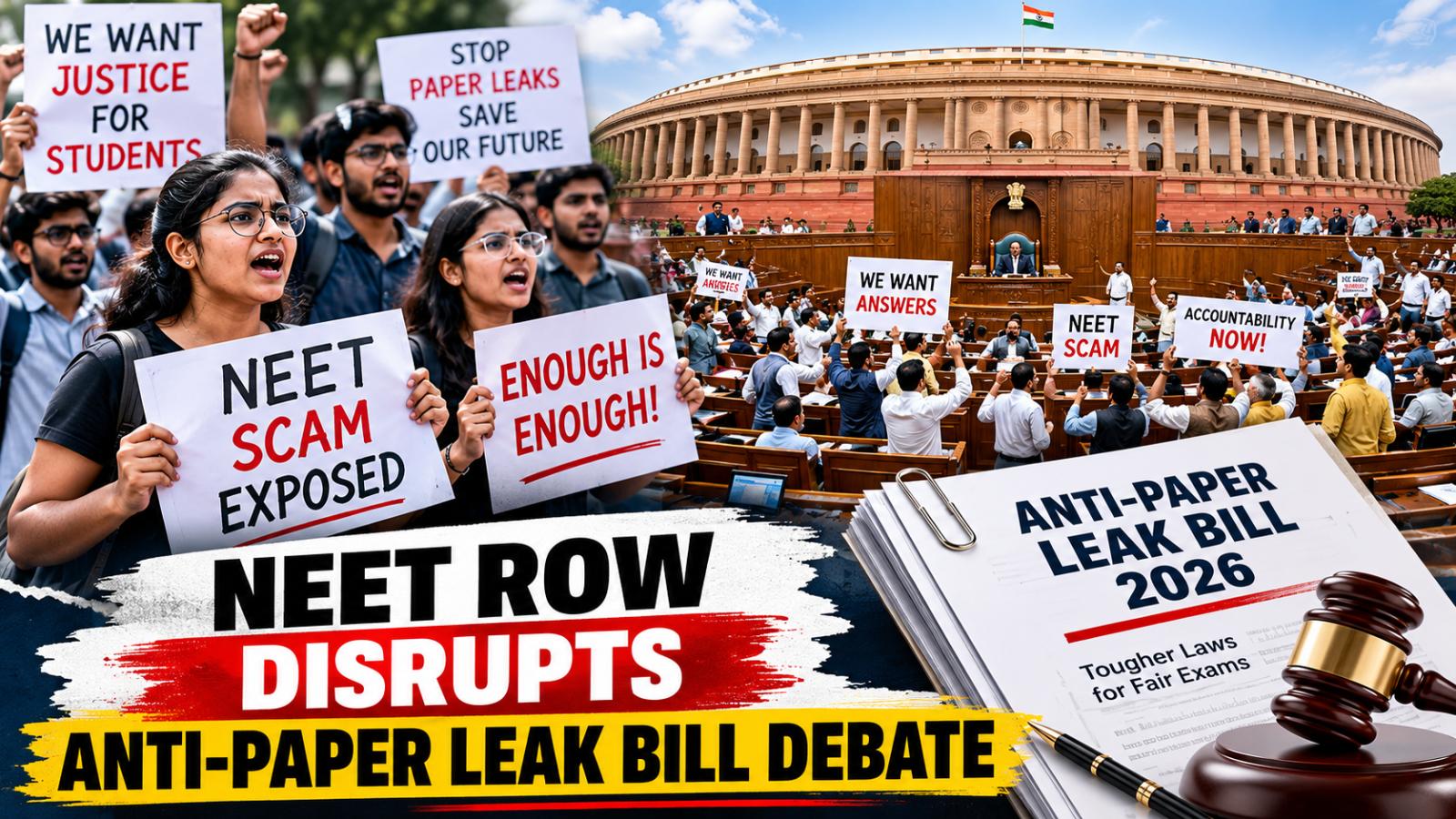
The Lok Sabha was adjourned amid Opposition protests over the alleged use of force against NEET demonstrators, even as the Centre prepared to introduce a stricter anti-paper leak Bill with tougher penalties and fast-track trials.Lok Sabha Adjourned as NEET Protest Row Dominates Session
New Delhi, July 27, 2026: The anti-paper leak Bill 2026 Parliament debate faced an immediate political roadblock on Monday as Opposition protests disrupted the Lok Sabha shortly after proceedings began.
The House was adjourned until noon amid sloganeering by Opposition MPs demanding accountability for the police action against students during the July 20 demonstration near Delhi’s Jantar Mantar. The government had listed the Public Examinations (Prevention of Unfair Means) Amendment Bill, 2026, for introduction during the day’s proceedings.
Union Minister Jitendra Singh was scheduled to seek permission to introduce the legislation, which seeks to amend the Public Examinations (Prevention of Unfair Means) Act, 2024. The proposed changes are intended to strengthen action against question-paper leaks, organised examination fraud, and malpractice involving examination service providers.
Anti-Paper Leak Bill 2026 Parliament Provisions
The proposed amendment significantly increases the punishment for individuals convicted of using unfair means in public examinations.
Under the existing law, such offences can attract imprisonment ranging from three to five years and a fine of up to ₹10 lakh. The amendment proposes increasing the punishment to a minimum of five years and a maximum of 10 years, along with a fine of up to ₹50 lakh.
Service providers—including private companies engaged for printing papers, managing examination centres, providing technology or handling logistics—could face a maximum penalty of ₹5 crore. Agencies found responsible could also be barred from participating in public examinations for eight years.
For organised examination crimes involving institutions, examination authorities, or coordinated networks, the proposed minimum prison term would increase to seven years. The minimum financial penalty for organised offences could rise to ₹10 crore. This explains why separate figures of ₹50 lakh and ₹10 crore have appeared in reports: they apply to different categories of offences.
Fast-Track Courts Proposed for Paper Leak Cases
The Bill also focuses on reducing delays in investigations and court proceedings.
Investigating agencies or special task forces would be expected to complete probes within two months. States and Union Territories would be required to designate special fast-track courts for offences covered by the law.
These courts would conduct proceedings on a day-to-day basis and aim to complete trials within three months of the filing of a chargesheet. The legislation also proposes dedicated public prosecutors and a separate mechanism for appeals before High Court benches.
Opposition Raises Police-Action Allegations
While the government sought support for the examination-reform legislation, Opposition parties shifted their focus towards the alleged use of excessive force against student protesters on July 20.
Congress, CPI, DMK, and other Opposition MPs submitted notices seeking discussions in both Houses. Several leaders demanded a statement from Union Home Minister Amit Shah and an independent investigation into allegations that pellet guns, tear gas, and other forms of force were used against demonstrators.
These remain allegations raised by political parties and protesters, and responsibility for the reported actions has not been established through an independent inquiry.
Congress MPs also sought an apology from Prime Minister Narendra Modi, while some Opposition leaders argued that stricter legislation alone would not prevent paper leaks without transparent investigations and institutional reforms.
Earlier Examination Reforms Questioned
CPI(M) MP John Brittas and Congress leaders questioned the Centre’s decision to create another high-powered examination-reform panel. They asked why recommendations made by the K Radhakrishnan Committee, constituted after earlier examination of irregularities in 2024, had not been fully implemented.
The government has maintained that the new Bill, stronger penalties, technology-led reforms, and faster trials are necessary to restore confidence in public examinations.
The political challenge will now be whether the government and the opposition can agree to debate the proposed law while separately addressing demands for accountability over the treatment of protesting students.