
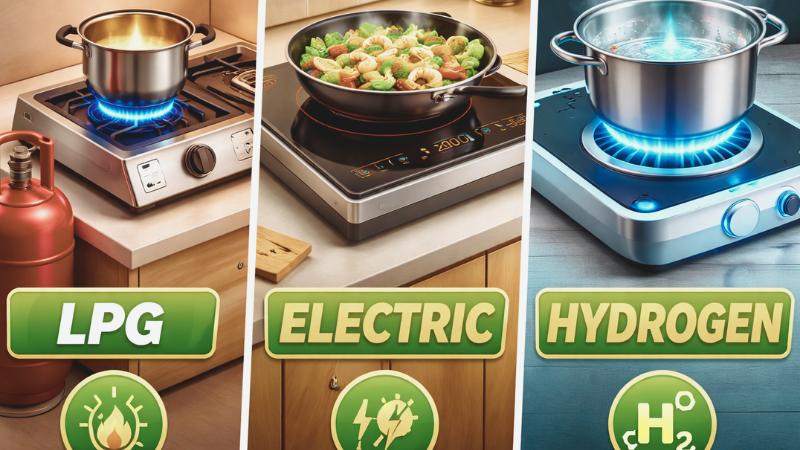
As India’s cooking landscape evolves with new technologies, many households are exploring alternatives to traditional fuels. A key question remains: which cooking option is the most affordable in 2026? A comparison of LPG, electric, and hydrogen cooking shows that costs can vary depending on usage, location, and infrastructure.
LPG: A Widely Used and Reliable Option
LPG continues to be the primary cooking fuel for millions of households across India due to its reliability and widespread availability. In 2026, the cost of a domestic LPG cylinder in many cities typically ranges between ₹900 and ₹1,100.
For a small to medium-sized family, one cylinder may last around 25 to 30 days, resulting in an estimated monthly expense of ₹900 to ₹1,200. While prices have seen gradual increases over time, LPG remains a practical and dependable choice, especially in areas with limited alternatives.
Electric Cooking: An Urban-Friendly Alternative
Electric cooking, particularly through induction cooktops, is becoming increasingly popular in urban households. It is considered cleaner and relatively easy to maintain, with efficient energy use as heat is directly transferred to the cookware.
However, electricity tariffs differ across states and consumption levels. Based on average usage, monthly cooking costs may range between ₹700 and ₹1,100. In regions with stable power supply and moderate tariffs, electric cooking can be a competitive option.
Hydrogen Cooking: An Emerging Concept
Hydrogen-based cooking is still at an early stage of development and is not yet widely available for household use in India. It is often discussed for its potential environmental benefits, as it produces water as a byproduct.
At present, the technology remains largely experimental, and there is limited data on real-world costs. As a result, hydrogen cooking is not considered a practical option for most households in 2026.
Affordability in 2026: What Should You Consider?
Comparing cooking costs involves more than just fuel prices. Factors such as availability, infrastructure, and consistency of supply also play an important role.
In some urban areas with reliable electricity, electric cooking may offer slightly lower monthly costs. However, LPG continues to be a dependable choice across both urban and rural regions. Hydrogen, while promising, is still not ready for everyday use.
There is no single answer to which cooking option is the cheapest in 2026. LPG remains a widely accessible and reliable choice for most households, while electric cooking is gaining traction in cities with a stable power supply. Hydrogen cooking, although promising for the future, is currently not a viable alternative. Ultimately, the best option depends on individual needs, local infrastructure, and usage patterns.