

Tamil Nadu Spectrum Project: Police Colour-Code High-Risk Offenders To Strengthen Women’s Safety
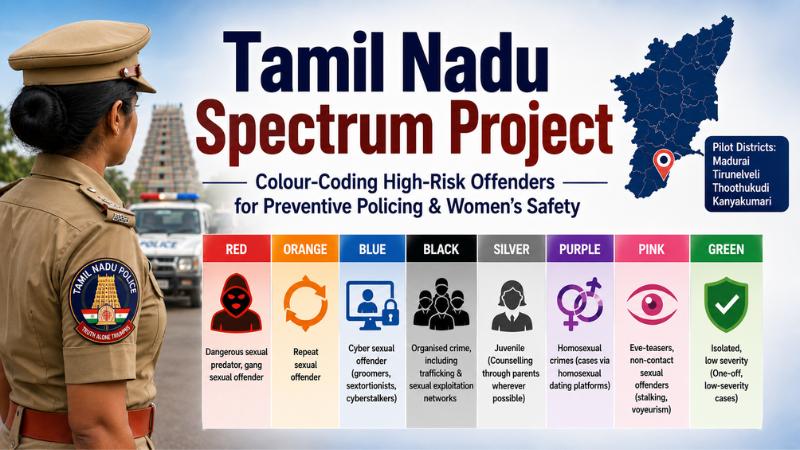
Tamil Nadu Police have launched a pilot initiative called the Spectrum Project to classify and monitor people linked to sexual offence cases based on their risk level. The colour-coded system is aimed at helping police identify high-risk offenders, repeat offenders, cyber offenders, and low-severity cases separately, allowing more focused preventive action.
The project is being implemented in Tamil Nadu’s southern districts, including Madurai, Tirunelveli, Thoothukudi, and Kanyakumari. According to police inputs cited in reports, the southern region records around 1,500 to 2,000 sexual offence cases every year, making risk-based monitoring an important policing priority.
How The Spectrum Project Works
Under the Spectrum Project, accused or convicted persons are classified into different colour categories based on the nature of the offence, seriousness of the case, and possible risk of repeat crime. The system is designed to help police prioritise monitoring instead of applying the same level of attention to every case.
The red category is used for the highest-risk cases, including dangerous sexual predators and gang sexual offence cases. Orange is used for repeat offenders, while blue covers cyber-related cases such as online grooming, sextortion and cyberstalking.
The black category is linked to organised crime, including trafficking and commercial sexual exploitation networks. Silver is used for juvenile cases, pink covers non-contact offences such as stalking and voyeurism, and green is meant for isolated or low-severity cases.
Focus On Preventive Policing
The main objective of the project is preventive policing. Police are expected to closely monitor high-risk and repeat offenders, especially those out on parole or facing pending cases.
Authorities are also using provisions under Section 126 of the Bharatiya Nagarik Suraksha Sanhita, or BNSS, to make high-risk individuals execute bonds for good behaviour where required. This legal provision allows preventive action when a person is considered likely to disturb public peace.
Police are also reported to be pursuing convictions in pending cases and seeking cancellation of bail in serious cases. The idea is to prevent repeat offences and strengthen public safety, rather than responding only after a fresh crime is committed.
Why The Project Matters
The Spectrum Project reflects a shift towards data-driven and risk-based policing. By identifying repeat and high-risk individuals, police can use resources more effectively and improve monitoring in sensitive cases.
The project also recognises newer forms of crime, especially online sexual offences. With cyberstalking, sextortion, and online grooming becoming major concerns, a separate category for cyber offenders may help police track such cases more closely.
Public Safety And Legal Safeguards
While the initiative is being seen as an important step for women’s safety, it also raises questions about privacy, profiling, and due process. Since some people may be accused but not yet convicted, authorities must ensure that the system does not violate the presumption of innocence.
A clear legal framework, regular review, data protection rules, and independent oversight will be necessary to prevent misuse. Any monitoring system should balance public safety with constitutional rights, privacy protections, and fair legal procedure.
Need For Victim-Centric Support
Experts say offender monitoring alone will not be enough unless it is supported by faster trials, survivor assistance, witness protection and rehabilitation measures. Counselling, legal support and timely investigation are also important to ensure justice for victims.
The success of the Spectrum Project will depend on how transparently it is implemented and whether it can prevent repeat offences while respecting legal safeguards. If handled carefully, the project could become an important model for preventive policing and women’s safety in Tamil Nadu.