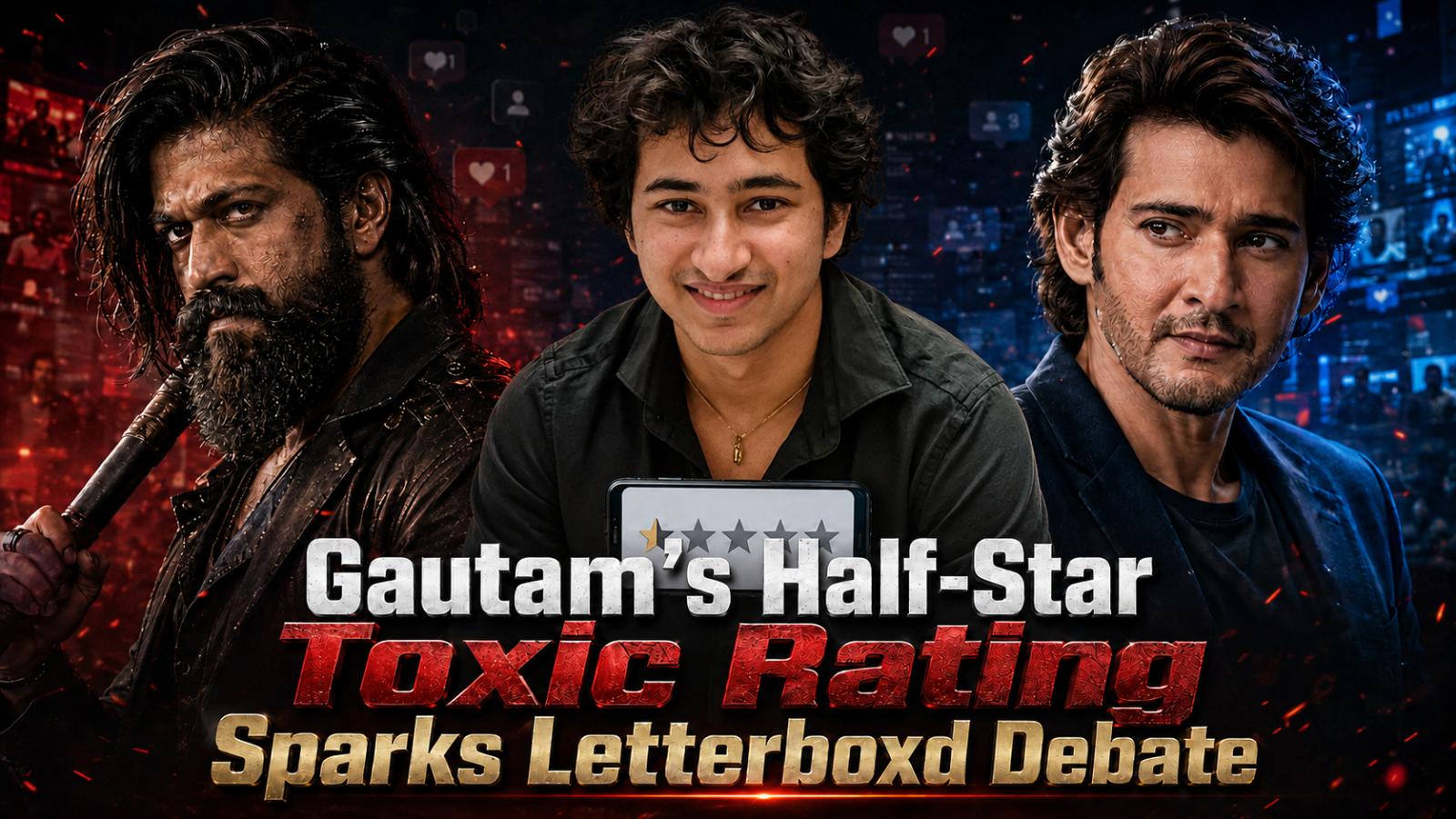
A Letterboxd account attributed to Mahesh Babu’s son, Gautam Ghattamaneni, has become a major talking point among film fans. His half-star rating for Yash’s Toxic, along with mixed scores for several Mahesh Babu films, has triggered debate about personal taste, honest criticism and whether family connections should influence movie ratings.
Toxic Rating Sparks Online Discussion
Gautam attracted attention after fans discovered that the account had given Toxic only half a star. The period gangster drama, starring Yash, had already received mixed responses despite its ambitious scale, making Gautam’s low score another subject of discussion surrounding the film.
Some users considered the rating unnecessarily harsh, while others defended it as an individual opinion. The account also gave Liger half a star and rated Kalki 2898 AD 2.5 stars, suggesting that Toxic was not the only major Indian production to receive a low score.
Mixed Ratings for Mahesh Babu’s Films
The profile drew wider attention because it did not appear to favour Mahesh Babu’s films automatically. Gautam reportedly awarded five stars to Pokiri and 1: Nenokkadine, recognising two very different performances from his father.
However, Nijam and Vamsi received two stars each, while Brahmotsavam was rated just one star. These scores surprised fans who expected a more generous assessment of Mahesh Babu’s work. The discussion also expanded into a broader debate about the actor’s filmography, with some fans arguing that recent commercial successes have not achieved the same lasting impact as Pokiri, Dookudu and Athadu.
Ratings Reflect a Wide Interest in Cinema
The account presents Gautam as a serious film enthusiast who has watched more than 400 titles across different languages and genres. Five-star ratings were given to Sholay, Project Hail Mary, Knives Out, Jersey and Baahubali 2.
Pelli Choopulu, Sita Ramam, The Odyssey and Spider-Man: Brand New Day received 4.5 stars, while Eega and Lokesh Kanagaraj’s DC were rated four stars. The two Dhurandhar films received different scores, with the first earning four stars and the sequel receiving three. Ravi Teja’s Irumudi was also rated three stars.
Debate Over Personal Opinion and Family Loyalty
Fans have interpreted the ratings in sharply different ways. Some praised Gautam for judging films independently, without favouring stars, languages or even his father. Others questioned whether such blunt scores were fair, particularly when attached to highly anticipated films.
The debate ultimately raises a larger question: should the child of a superstar be expected to publicly support every film made by a parent? Personal ratings are subjective and do not represent a definitive measure of quality. Unless the account’s ownership is independently verified, its ratings should also be treated with appropriate caution. Even so, the discussion shows how quickly a private movie opinion can become a major topic when it is linked to a prominent film family.