

Solar Storm Hits Earth: Will India See Auroras This Week?
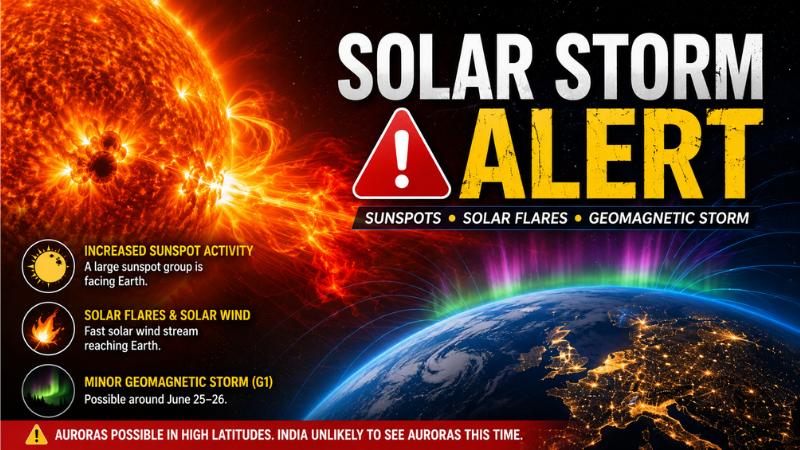
Earth is experiencing increased solar activity this week as a large sunspot group and a fast solar wind stream raise the possibility of a minor geomagnetic storm around June 25 and 26. The event has sparked curiosity over whether India could witness auroras, but scientists say the chances remain very low.
The solar activity is not considered dangerous for the public. However, it is a reminder of how powerful events on the Sun can affect Earth’s magnetic field, satellites, communication systems, and night skies.
What Is Causing The Solar Storm?
The current space weather activity is linked to a large group of sunspots that recently rotated into direct view of Earth. Sunspots are darker-looking areas on the Sun’s surface caused by strong magnetic activity.
These regions appear dark because they are cooler than the surrounding solar surface. While the Sun’s surface is extremely hot, sunspots are slightly cooler due to intense magnetic fields that block heat from rising normally.
When magnetic fields around sunspots become highly twisted and unstable, they can release sudden bursts of energy known as solar flares. In some cases, they can also send huge clouds of charged particles into space. These are called coronal mass ejections, or CMEs.
What Happens When Solar Material Reaches Earth?
Earth is protected by a magnetic shield called the magnetosphere. This shield blocks or redirects much of the charged material coming from the Sun.
When strong solar particles interact with Earth’s magnetic field, they can create a geomagnetic storm. These storms are ranked from G1 to G5. A G1 storm is considered minor, while a G5 storm is extreme.
The current forecast points only to a minor G1-level geomagnetic storm. Such storms may cause limited effects on satellites and power systems, but they are generally not a major threat.
Why Do Auroras Appear?
Auroras form when charged particles from the Sun enter Earth’s upper atmosphere near the polar regions. These particles collide with gases in the atmosphere, causing colourful light displays known as the northern lights and southern lights.
During strong geomagnetic storms, auroras can sometimes move farther away from the poles and become visible in unusual places. But this usually requires a much stronger storm than the one expected this week.
Will India See Auroras?
India is almost certain not to see auroras from this solar storm. A minor geomagnetic storm usually pushes auroras only slightly southward, mainly toward higher-latitude regions such as parts of northern Europe, Canada, Scotland, or the northern United States.
For auroras to be visible from India, the solar storm would need to be extremely powerful. In rare cases, faint red auroras have been observed from dark high-altitude regions such as Ladakh, but such events are unusual.
This week’s solar activity may be scientifically interesting, but it is unlikely to produce visible auroras in most parts of India.
Why This Solar Activity Matters
The Sun is approaching the active phase of its 11-year solar cycle, known as solar maximum. During this period, sunspots, solar flares, and geomagnetic storms become more frequent.
Most solar storms pass without major disruption, but strong events can affect satellites, GPS signals, radio communication, and power grids. That is why space weather agencies closely monitor solar activity.
For now, the expected storm is minor. It offers a useful chance to understand how the Sun influences Earth from nearly 150 million kilometres away.
Final Takeaway
The June 25–26 solar storm may create auroras in some high-latitude regions, but India is unlikely to witness the display. The event is not a public emergency, but it highlights the growing activity of the Sun as it moves closer to solar maximum.