
Amaravati vs MaViGun: Andhra Capital Debate Returns As Jagan Pitches New Alternative
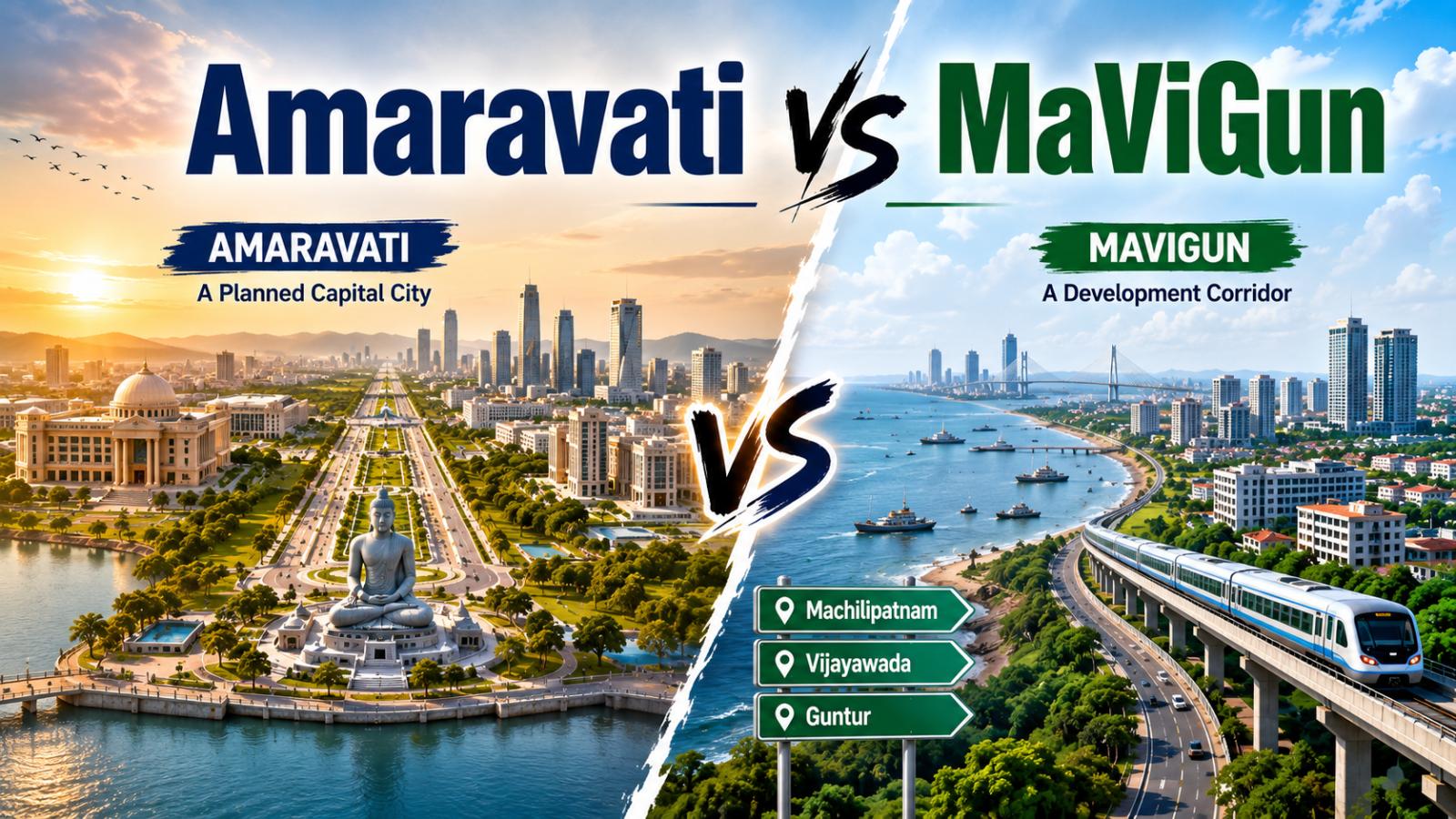
Andhra Pradesh’s capital question is back at the centre of state politics, with YSRCP chief YS Jagan Mohan Reddy pitching MaViGun — a proposed Machilipatnam-Vijayawada-Guntur development corridor — as an alternative development model to Amaravati.
The debate comes even after Amaravati received statutory backing as Andhra Pradesh’s sole capital through the Andhra Pradesh Reorganisation Amendment Bill, 2026. But politically, the issue remains far from settled, as Jagan has now turned the capital question into a key talking point ahead of the 2029 Assembly election.
What Is MaViGun?
MaViGun is a proposed development corridor linking Machilipatnam, Vijayawada, and Guntur. Instead of building a greenfield capital city from scratch, the idea focuses on strengthening existing urban centres that already have economic activity, transport links, and administrative relevance.
Jagan argues that Andhra Pradesh should not spend heavily on building a massive capital city when the state can develop a practical coastal corridor using already established towns.
This makes MaViGun different from the earlier three-capital proposal of the YSRCP government—the three-capital plan aimed to divide administrative functions among Visakhapatnam, Amaravati, and Kurnool. MaViGun, however, keeps the focus within Coastal Andhra and presents itself as a development corridor rather than a split-capital model.
Why Amaravati Still Matters
N Chandrababu Naidu chose Amaravati after Andhra Pradesh lost Hyderabad to Telangana following bifurcation in 2014. The TDP government projected Amaravati as a “people’s capital” and used a land-pooling model under which thousands of farmers gave land in exchange for developed plots and annuities.
Supporters of Amaravati say the project gives Andhra Pradesh a clear administrative centre, improves investor confidence, and honours commitments made to farmers. They argue that changing the capital plan repeatedly has hurt the state’s credibility and delayed long-term development.
After Naidu returned to power in 2024, the Amaravati project regained momentum with fresh political backing. In April 2026, Parliament passed legislation giving Amaravati statutory recognition as the sole capital of Andhra Pradesh.
Why Jagan Is Reviving The Capital Debate
Jagan has accused the Amaravati project of being financially unsustainable and has described it as a project that benefits select interests. His MaViGun pitch is based on three main points: lower cost, use of existing infrastructure, and wider development across an urban corridor.
The YSRCP chief has also tried to shift the debate from regional balance to financial prudence. By choosing MaViGun, he is no longer pushing the older three-capital argument in the same form. Instead, he is comparing a greenfield capital model with a corridor-based development model.
This gives the YSRCP a fresh political line against the TDP while avoiding some of the regional criticism that surrounded the three-capital plan.
Amaravati vs MaViGun: What Is The Main Difference?
The Amaravati model is built around a single, planned capital city with the legislature, secretariat, high court, and major administrative infrastructure centred in one location.
The MaViGun model, on the other hand, proposes to develop a wider corridor around Machilipatnam, Vijayawada, and Guntur. Supporters say this could reduce pressure on public finances and spread growth across already active towns.
In simple terms, Amaravati represents administrative certainty and a planned capital vision, while MaViGun represents a corridor-based approach that claims to be more practical and cost-conscious.
Political Impact Ahead Of 2029
The capital issue has repeatedly shaped Andhra Pradesh politics since the bifurcation. Farmers, investors, government employees, and regional groups have all been affected by changing policy positions over the years.
For the TDP, Amaravati remains a symbol of stability, investment, and the promises made to land-pooling farmers. For the YSRCP, MaViGun is being positioned as a more economical and realistic alternative to what it calls an expensive capital project.
Even though Amaravati’s legal position has been strengthened, Jagan’s MaViGun pitch shows that the political battle over Andhra Pradesh’s capital is not over. The 2029 election may now see the issue return as a direct contest between two competing development models.
What Lies Ahead For Andhra’s Capital Debate
The Amaravati vs MaViGun debate is no longer just about the location of Andhra Pradesh’s capital. It reflects two different development models — one focused on a planned capital city and the other built around an existing coastal corridor.
With Amaravati legally recognised as the state’s capital and MaViGun emerging as a political alternative, the issue is likely to remain an important talking point in Andhra Pradesh politics ahead of the 2029 Assembly elections.