

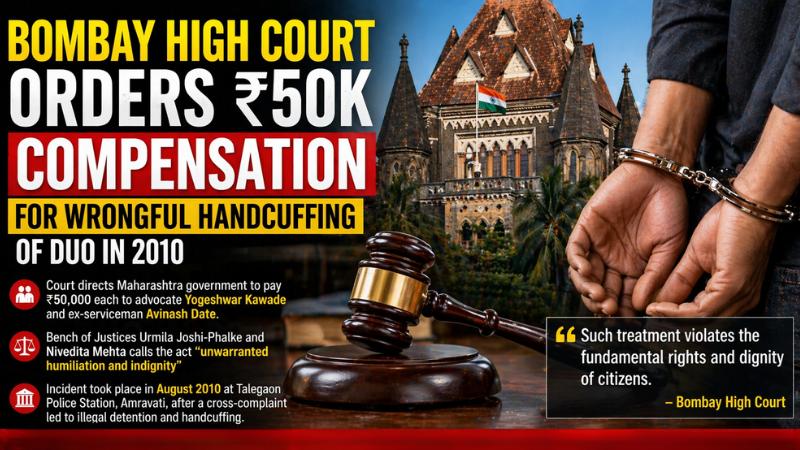
The Bombay High Court has directed the Maharashtra government to pay ₹50,000 each as compensation to advocate Yogeshwar Kawade and former serviceman Avinash Date for wrongful handcuffing by police in a 2010 case. A division bench comprising Justices Urmila Joshi-Phalke and Nivedita Mehta held that the act amounted to “unwarranted humiliation and indignity,” underlining that such treatment violates the fundamental rights and dignity of citizens.
The court strongly emphasized that law enforcement authorities must not only follow legal procedures but also respect the dignity of individuals. It observed that any action by the police that undermines a citizen’s basic rights cannot be justified under the law. The bench reiterated that the justice system must ensure accountability when state authorities overstep their powers.
The incident dates back to August 2010 at Talegaon Police Station in Amravati district, Maharashtra, where Kawade and Date had gone to file a complaint against a man who allegedly damaged Date’s car. However, the accused lodged a cross-complaint accusing them of assault and threats. Based on this, police detained the duo after midnight. According to their petition, they were forced to strip and made to sit in their undergarments, and the next day they were handcuffed and taken by a state transport bus to a magistrate’s court, where they were granted bail.
The petitioners argued that the police action was illegal, defamatory, and excessive, pointing out that they were neither habitual offenders nor hardened criminals. They maintained that the use of handcuffs was completely unjustified and caused severe humiliation. While the Superintendent of Police, Amravati, informed the court that departmental action had been taken against the officers involved, the bench noted that such internal measures alone were not enough to address the violation.
Stressing the need for meaningful judicial redress, the court ordered that compensation be paid within eight weeks. It observed that monetary relief was necessary to repair the legal injury caused and to uphold constitutional protections. The judgment reinforces the principle that the dignity of every citizen must be protected and that any violation by authorities will invite accountability under the law.