
CJP Protest Expands as Global Media Examines Modi Government Response
The CJP-led Jantar Mantar agitation has attracted international media attention while drawing students, parents and professionals from different parts of India. The widening participation has raised questions about whether it could become a broader political challenge for the Modi government.
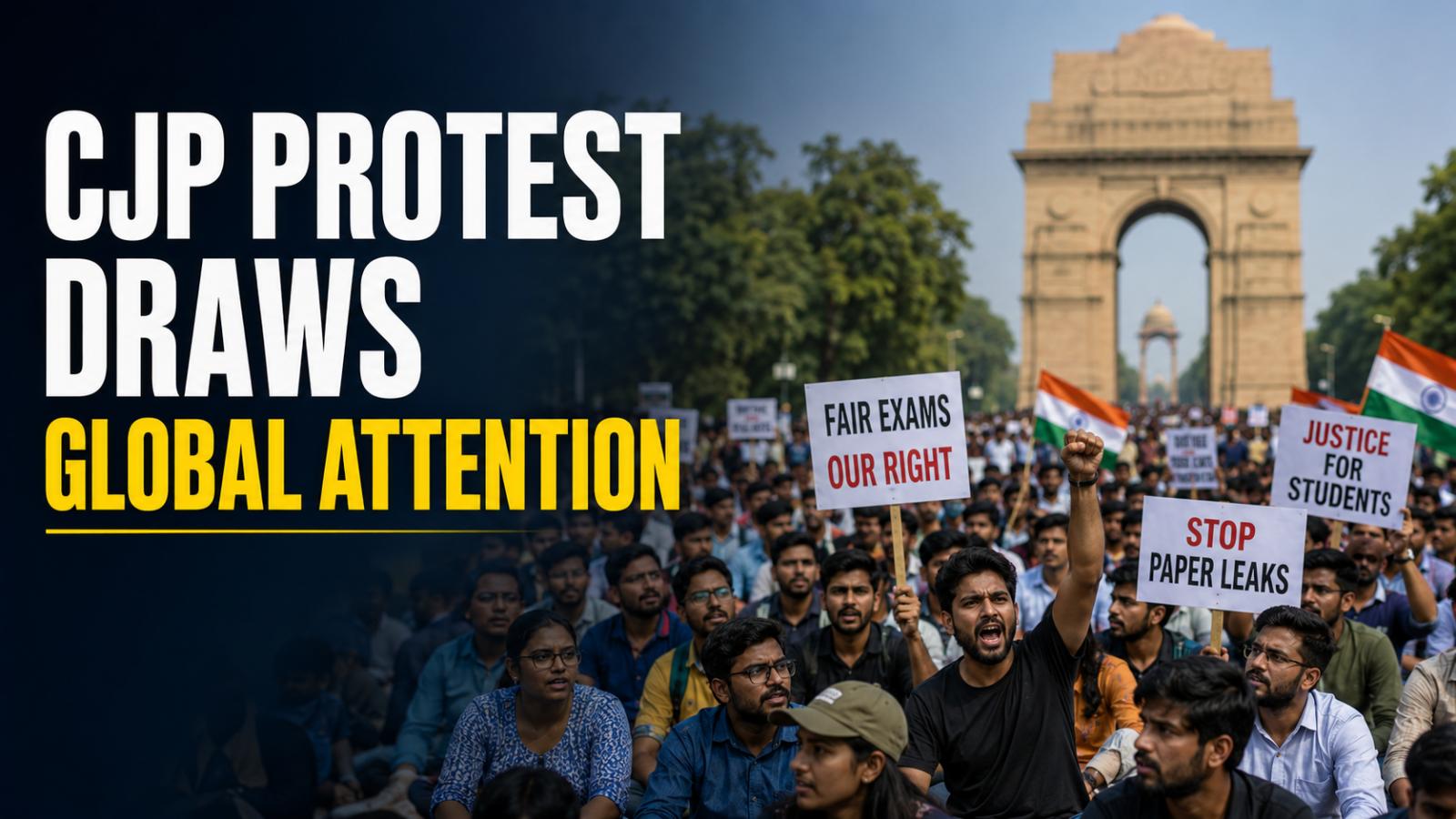
New Delhi, July 22, 2026: The continuing CJP-led protest at Jantar Mantar has drawn international attention and intensified political pressure on the Narendra Modi government over the alleged NEET-UG paper leak and concerns surrounding India’s competitive examination system.
The agitation gained momentum after thousands of protesters attempted to march towards Parliament on Monday. Police used barricades, tear gas and batons to stop the demonstrators from advancing towards the Parliament complex.
Several protesters were detained, while demonstrators and police personnel were reportedly injured during the confrontation. Protest organisers have demanded accountability over the examination controversy, wider reforms, and the resignation of Union Education Minister Dharmendra Pradhan.
International media focuses on Delhi protest
The protest featured prominently in reports by international publications, which focused on the chaotic scenes near Parliament and the government’s handling of the demonstration.
A global-media roundup reported that The New York Times examined the contrast between Prime Minister Modi’s calm public appearance at the opening of the Parliament session and the protests unfolding on nearby roads.
Foreign publications also questioned whether the agitation could affect the Prime Minister’s carefully built image of political stability. However, such conclusions remain interpretations by media organisations and do not establish that the protest has caused a lasting change in Modi’s political position.
International coverage has also highlighted the police response, the number of people detained, and the protesters’ allegation that the government has not adequately addressed their demands.
Protesters return despite police action
Crowds returned to Jantar Mantar on Tuesday despite the previous day’s clashes and a strong police presence.
The protest site remained surrounded by barricades, Delhi Police personnel, and members of the Rapid Action Force. Some young protesters reportedly returned with visible injuries and bandages.
Others said they decided to travel to Delhi after seeing videos of the police action during the Parliament march. Participants arrived from Delhi as well as other states, suggesting that the campaign was beginning to attract support beyond its original group of organisers.
The continuing turnout has led some political observers to describe the agitation as a broad-based protest rather than a movement representing one profession, region, or narrowly defined interest group.
Students joined by parents and professionals
The protest initially centred on students affected by examination irregularities. It has since attracted parents, teachers, working professionals, and people concerned about unemployment and the credibility of public examinations.
Unlike movements linked to a single community or sector, concerns surrounding examination fairness can affect families across social, regional, and economic groups.
This wider appeal has prompted comparisons with previous major protests faced by the Modi government. However, the current agitation is still at an early stage, and it remains uncertain whether it will maintain its momentum or develop into a sustained nationwide movement.
The description of the protest as Modi’s first broad-based agitation is an analytical view and should not be treated as an uncontested political fact.
Sonam Wangchuk’s fast increases visibility
Education reformer and climate activist Sonam Wangchuk has become one of the most prominent public figures associated with the campaign.
His hunger strike increased public and media attention around the protest. Wangchuk’s involvement has also helped the agitation attract supporters who view it as a movement for education reform and government accountability rather than solely a party-led political campaign.
Concerns over his health and his subsequent hospitalisation further increased attention on the movement. Supporters continued gathering at Jantar Mantar and said the protest would continue until the Centre offered a satisfactory response.
Opposition steps up political pressure
Opposition leaders have also joined the campaign and criticised the police action against protesters.
Congress leaders, including Rahul Gandhi and Priyanka Gandhi Vadra, participated in demonstrations linked to the agitation. Their involvement has increased political pressure on the Centre but has also raised questions about whether the protest will remain citizen-led or gradually become dominated by Opposition parties.
The organisers face the challenge of retaining support from politically diverse participants while keeping the movement focused on examination reforms and accountability.
Centre promises stronger examination system
Prime Minister Modi has called for a foolproof examination system to prevent future paper leaks and has demanded strict punishment for those responsible.
The government has said it is committed to protecting the interests of students and addressing weaknesses in the examination process. Education Minister Dharmendra Pradhan has also indicated that the Centre is prepared to discuss the issue.
However, protesters have demanded visible action, transparency, and a clear timeline for reforms rather than general assurances.
Political impact remains uncertain
The combination of international attention, continuing crowds, and participation from different sections of society has made the CJP protest politically significant.
Nevertheless, it is too early to conclude that the agitation has permanently damaged the Modi government or developed into a nationwide political movement.
Its future will depend on whether organisers can maintain peaceful mobilisation, whether the government offers concrete reforms and whether negotiations produce an acceptable resolution.