

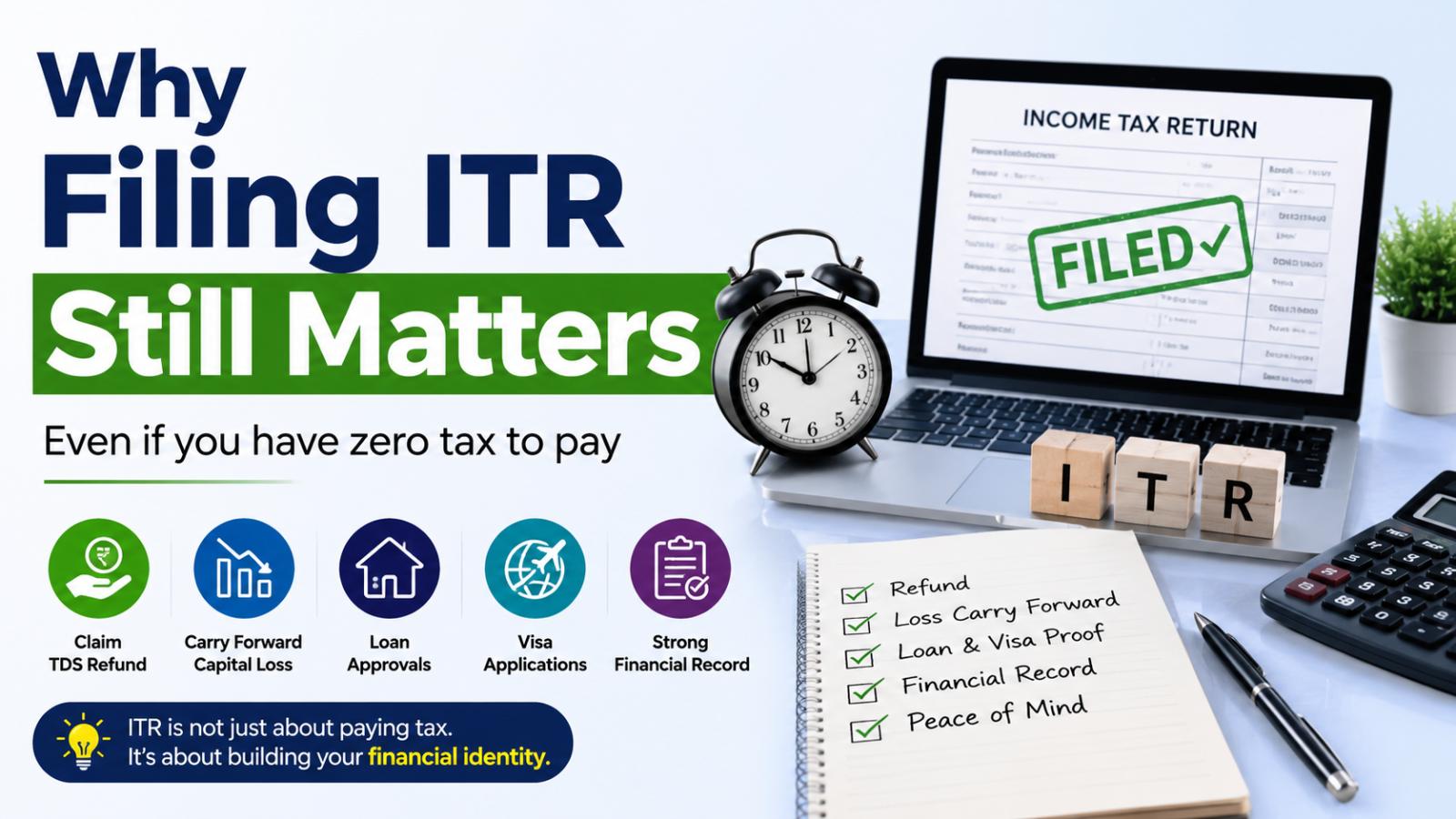
Why Filing ITR Matters Even When No Tax Is Payable
Filing an income tax return can remain useful even when your final tax liability is zero. A timely ITR may help you claim excess TDS, carry forward eligible investment losses, document your income, and support future loan or visa applications.
Benefits of Filing ITR With Zero Tax: 5 Reasons It Matters
The benefits of filing ITR with zero tax extend well beyond calculating and paying income tax. Even when your final tax liability is nil, filing an income tax return can help you recover excess TDS, preserve eligible losses and maintain an official record of your income.
Taxpayers should, however, confirm the deadline applicable to their return form. Income Tax Department messages identify July 31, 2026 as the due date for many returns for Assessment Year 2026-27. However, the department’s ITR-4 FAQ lists August 31, 2026 as the deadline for eligible ITR-4 taxpayers. The correct date therefore depends on the taxpayer’s category and applicable form.
Benefits of Filing ITR With Zero Tax in AY 2026-27
Under the new tax regime, eligible resident individuals can receive a rebate of up to ₹60,000 when taxable income does not exceed ₹12 lakh. Salaried taxpayers may also claim a standard deduction of up to ₹75,000. In a straightforward salary-only case, this can result in nil regular tax on gross salary of up to ₹12.75 lakh, subject to the taxpayer’s eligibility and the nature of income.
Having no tax payable, however, does not make an income tax return useless. Filing and paying tax are two different activities.
1. Claim excess TDS as a refund
Tax may have been deducted from salary, fixed-deposit interest, professional payments or another source even though the taxpayer’s final liability is zero.
Filing an ITR allows the taxpayer to report the TDS credit and claim the eligible excess amount as a refund. The Income Tax Department states that excess tax paid can be claimed through the return and, after processing and acceptance, credited to the taxpayer’s bank account.
Before claiming a refund, taxpayers should compare their TDS details with Form 26AS, the Annual Information Statement and relevant certificates such as Form 16 or Form 16A.
2. Carry forward eligible capital losses
Investors who sold shares, mutual funds or other capital assets at a loss may be able to use that loss against eligible capital gains in later years.
Capital losses can generally be carried forward for eight assessment years, subject to the applicable set-off rules. Filing the return within the prescribed deadline is particularly important because certain losses may not be carried forward when the return is filed late.
The nature of the loss must also be reported correctly. Long-term and short-term capital losses do not have identical set-off rules.
3. Create an official income record for loans
An ITR acknowledgement provides a documented summary of the income declared by a taxpayer. This can be useful when applying for a home, vehicle, education or business loan, particularly for self-employed people who may not receive regular salary slips.
Document requirements differ between lenders and loan products. For example, SBI lists Form 16 or the latest ITR-V among the income documents accepted for certain education-loan applications. Filing an ITR does not guarantee loan approval, but it can strengthen the applicant’s income-documentation file.
4. Support financial documentation for visa applications
Some visa categories require applicants or sponsors to submit evidence of income and financial stability. Depending on the country and visa type, tax returns may form part of the financial documentation requested by immigration authorities.
The exact requirements vary considerably, so applicants should follow the checklist issued for their destination and visa category. A consistent ITR history can nevertheless provide an additional formal record of income when such evidence is requested.
5. Maintain a clear financial and tax record
Paying tax and filing an ITR are not the same. Tax payment settles a liability, while the return reports income, deductions, taxes already paid and any refund being claimed.
The Income Tax Department also clarifies that income on which an employer or bank has deducted TDS must still be disclosed in the return when filing is applicable, and the corresponding TDS credit should be claimed.
A properly filed return can therefore help create continuity in a taxpayer’s financial records and reduce discrepancies between declared income, TDS information and reported financial transactions.
Check the applicable deadline before filing
Taxpayers should select the correct ITR form, reconcile Form 16, Form 26AS and AIS, report all taxable income and review bank details before submission. The return must also be verified after filing; the department’s guidance refers to a 30-day period for sending ITR-V when physical verification is used.30 days
Zero tax payable does not always mean that filing is unnecessary. Whether an ITR is legally mandatory depends on income, residential status, financial transactions and other statutory conditions. Taxpayers with capital gains, foreign assets, business income or complicated deductions should consider obtaining professional tax advice.
Disclaimer: This article provides general information and should not be treated as individual tax, legal or financial advice.