
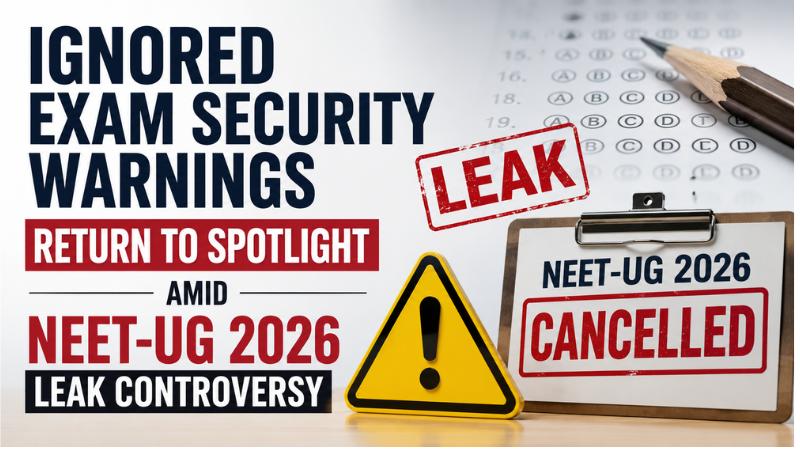
NEET-UG 2026 Leak Controversy Revives Debate Over Ignored Security Reforms
The controversy surrounding alleged irregularities in NEET-UG 2026 has reignited national debate over examination security reforms that were recommended earlier but reportedly not fully implemented by the National Testing Agency. The issue gained attention after claims surfaced online alleging that a circulated “guess paper” closely resembled portions of the actual medical entrance examination.
A parliamentary committee headed by Digvijaya Singh had previously raised concerns regarding the functioning of the NTA and recommended several reforms aimed at preventing paper leaks and improving transparency in national-level examinations. The panel had reviewed controversies linked to examinations such as NEET, JEE, CUET, UGC-NET and CSIR-NET following repeated complaints and operational concerns.
Among the key recommendations made by the committee was reducing dependence on private vendors involved in examination logistics, paper handling, and technical operations. The panel reportedly warned that excessive outsourcing could create vulnerabilities within the system. It also suggested stricter accountability measures, permanent blacklisting of tainted firms, stronger audit mechanisms, and improved monitoring systems for large-scale examinations.
The committee also reportedly questioned whether sufficient investment had been made in strengthening examination security infrastructure. It is recommended that computer-based examinations should preferably be conducted at government or government-controlled centres instead of private institutions wherever possible. The panel further advised the NTA to study examination models followed by organisations such as the Union Public Service Commission and the Central Board of Secondary Education, which are generally viewed as more reliable by many observers.
However, several recommendations reportedly remained under discussion because implementing them would require large-scale structural and logistical changes across India’s examination network. NEET alone involves lakhs of students and thousands of centres spread across multiple states. Experts have also debated whether future examination systems should rely more heavily on digital infrastructure or continue using traditional pen-and-paper methods with enhanced safeguards.
Despite reports of enhanced security measures, including biometric verification and digital monitoring during recent examinations, the latest controversy has once again raised concerns over the effectiveness of existing safeguards. Students, parents and education experts have renewed calls for stronger reforms, faster official communication, and stricter examination security protocols to protect the credibility of India’s competitive examination system.