

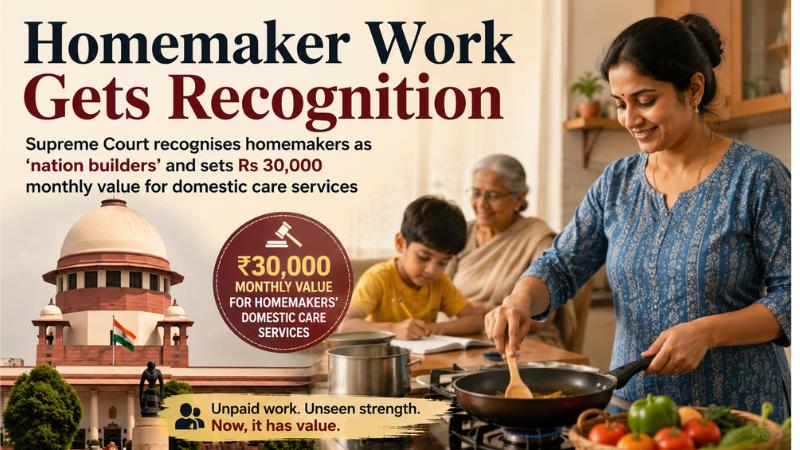
Supreme Court Homemaker Compensation Ruling Sparks Debate Over ₹30,000 Value
The Supreme Court’s decision to recognise homemakers as “nation builders” has sparked a wider debate on the value of unpaid household work in India. The court has said that domestic and caregiving services provided by homemakers must be treated as a separate category while calculating compensation in motor accident cases.
As part of the ruling, the court set a notional monthly value of ₹30,000 for homemakers’ domestic care services. The observation is being seen as an important step towards giving legal recognition to unpaid work done inside homes, even as many women say the real value of homemaking cannot be measured by one fixed amount.
Supreme Court Recognises Homemakers’ Work
The ruling marks a significant moment because homemakers’ labour has often been treated as invisible despite its daily importance. Cooking, cleaning, managing children’s education, caring for elderly family members, handling household needs, and providing emotional support are all part of the work that keeps families functioning.
The court noted that homemakers contribute not only to households but also to society. By calling them “nation builders”, the judgment gives legal weight to a role that has long been undervalued because it does not come with a salary slip.
Why ₹30,000 Became A Talking Point
The ₹30,000 monthly figure has become the centre of public discussion. For some, it is a welcome starting point because courts now have a benchmark while deciding compensation. For others, the amount is too low when compared with the cost of hiring separate people for cooking, cleaning, childcare, tuition support, elderly care, and household management.
Many homemakers believe the ruling matters more for recognition than for the amount itself. They say the judgment challenges the common belief that someone who stays at home is “not working”. The decision sends a message that unpaid domestic labour has economic value, even if it is difficult to calculate fully.
Not A Salary For All Homemakers
It is important to understand that the ruling does not mean every homemaker will receive ₹30,000 every month. The amount is a notional value to be considered in accident compensation cases, especially when courts calculate the financial loss caused by the death of a homemaker.
The judgment also does not say that every homemaker’s work is worth the same amount. Courts may still consider the facts of each case, including family background, responsibilities, and other circumstances. However, the ruling creates a minimum benchmark where such work was often ignored earlier.
Gender-Neutral Recognition Of Care Work
Another important part of the ruling is the use of the word “homemaker” instead of only “housewife”. This makes the recognition broader and more gender-neutral. It acknowledges that caregiving and household work can be done by women or men, depending on the family situation.
This language is important because it focuses on the work itself rather than only on gender. The value lies in domestic care, family support, and household management.
A Bigger Debate On Unpaid Labour
The Supreme Court’s ruling has reopened a larger conversation on how India values unpaid labour. Homemakers often give up careers, income opportunities, and personal ambitions to support families. Their contribution may not appear in official income records, but it directly supports earning members and the wider economy.
While ₹30,000 may not fully capture the emotional, physical, and daily labour involved, the ruling has given homemakers something many have long demanded: recognition.
For many families, the judgment is not only about compensation. It is about changing how society sees work done inside the home. The message is clear — homemaking is work, caregiving has value, and unpaid labour cannot be dismissed as nothing.