Kandula Jessie’s Journey From School Lab to Space Mission
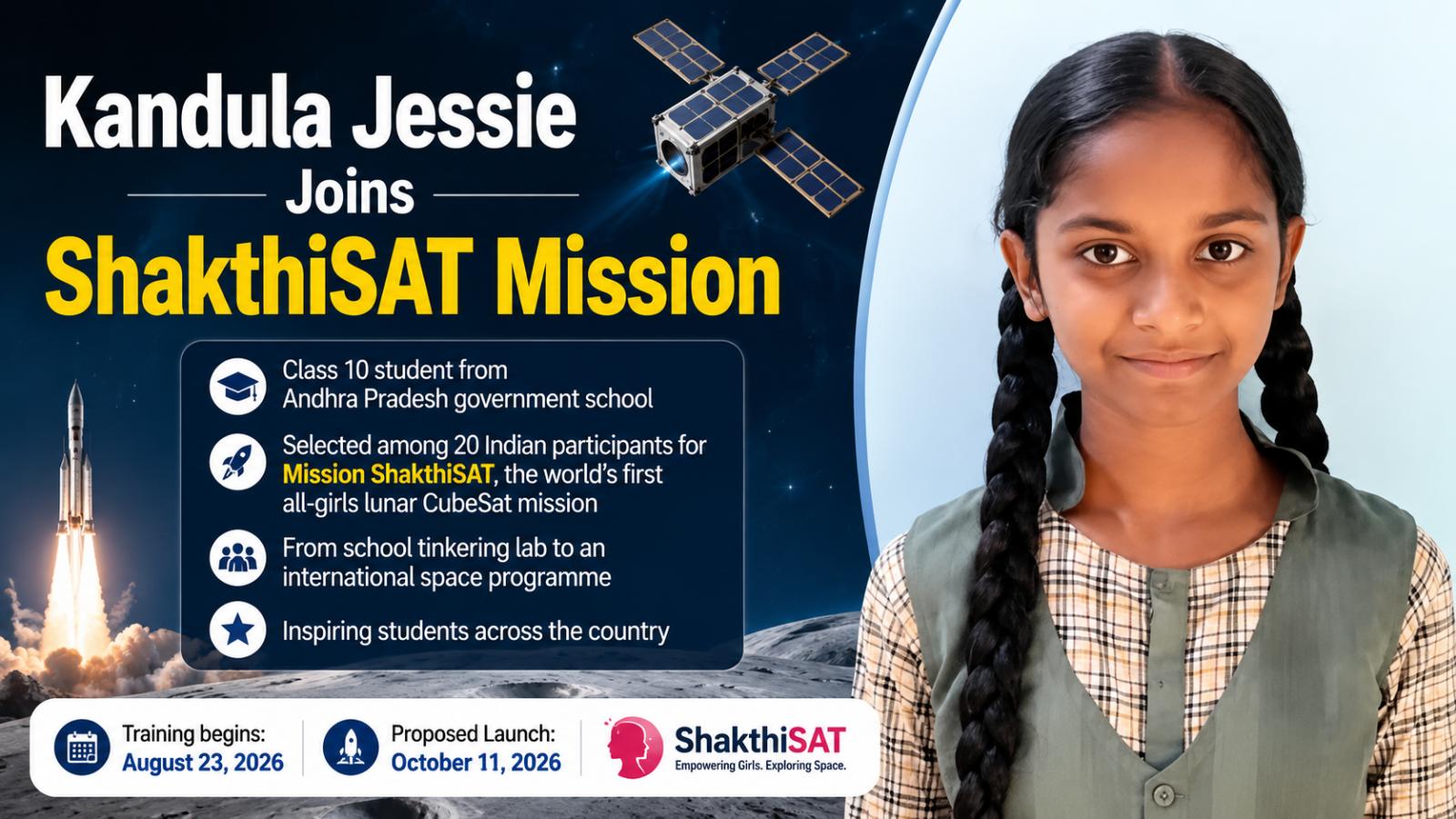
Kandula Jessie, a Class 10 student from an Andhra Pradesh government school, has been selected among 20 Indian participants for Mission ShakthiSAT. Her journey from a school tinkering lab to an international lunar CubeSat programme highlights the importance of STEM education, teacher support, and consistent effort.
A Government School Dream Reaches for the Moon
Dowleswaram, Andhra Pradesh, July 23, 2026: Fourteen-year-old Kandula Jessie has secured a place among 20 Indian participants selected for Mission ShakthiSAT, an international all-girls lunar CubeSat initiative.
Jessie studies at Zilla Parishad Girls High School in Dowleswaram and is reportedly the only student from Andhra Pradesh included in the final Indian group. She was selected through a programme involving nearly 12,000 girls from 108 countries.
How Kandula Jessie Earned Her Place
Jessie’s journey began at her school’s Atal Tinkering Lab. Her physical science teacher and laboratory in-charge, Manimala, recognised her interest in science and encouraged her to enrol in the programme.
The Mission ShakthiSAT curriculum covers subjects far beyond the regular Class 10 syllabus. Its modules include satellite systems, propulsion, thermodynamics, payload development, and other areas of space technology.
Jessie continued attending online classes after school, even when she found the advanced concepts difficult. The programme reportedly included around 550 online sessions across 21 learning modules.
Her determination to understand unfamiliar subjects helped her progress through the demanding selection process.
Selection Tested Knowledge and Communication Skills
The selection process involved online coursework, an interview lasting around one hour, and a short video presentation. Jessie was asked to explain Mission ShakthiSAT and discuss the importance of science, technology, engineering, and mathematics education.
The interview was conducted entirely in English with international scientists and programme coordinators. Jessie spent weeks improving her communication skills with the support of her teachers and educational videos.
Her selection reflected more than academic knowledge. It also demonstrated her willingness to improve, communicate confidently and continue learning despite the challenges.
Family Supported Her Through Financial Difficulties
Jessie’s father works as a carpenter. Her parents had earlier moved her from a private school to a government school because of financial difficulties.
Her mother, Aruna, described watching Jessie confidently interact with international scientists as one of the family’s proudest moments.
The achievement has also brought recognition to her school and the teachers who encouraged her scientific interests. Jessie’s success shows how timely guidance and access to practical learning opportunities can help students from modest backgrounds compete internationally.
ShakthiSAT Training to Begin in New Delhi
The next stage of Jessie’s programme is scheduled to begin in New Delhi on August 23, 2026. She is expected to work with scientists and other participants on satellite design, payload development, and mission operations.
The student-built lunar CubeSat is proposed for launch from Sriharikota on October 11, 2026. The launch schedule may remain subject to technical and operational confirmation.
Mission ShakthiSAT aims to give girls from different countries practical exposure to satellite development, space science and STEM education. The programme brings together students from 108 countries for scientific learning and collaborative space projects.
Jessie Hopes to Join ISRO
Jessie now hopes to build a career in space science and eventually join the Indian Space Research Organisation.
Her selection has strengthened her belief that determination and regular effort can help her achieve that goal. She also hopes to support her parents and make her teachers and school proud.
Her journey from a government-school laboratory to an international space programme underlines the value of Atal Tinkering Labs, supportive teachers, and accessible STEM opportunities.
For students from financially constrained families, Jessie’s achievement offers a powerful message: scientific talent can emerge from any classroom when curiosity receives the right guidance.
Kandula Jessie’s Journey From School Lab to Space Mission
Kandula Jessie, a Class 10 student from an Andhra Pradesh government school, has been selected among 20 Indian participants for Mission ShakthiSAT. Her journey from a school tinkering lab to an international lunar CubeSat programme highlights the importance of STEM education, teacher support, and consistent effort.
A Government School Dream Reaches for the Moon
Dowleswaram, Andhra Pradesh, July 23, 2026: Fourteen-year-old Kandula Jessie has secured a place among 20 Indian participants selected for Mission ShakthiSAT, an international all-girls lunar CubeSat initiative.
Jessie studies at Zilla Parishad Girls High School in Dowleswaram and is reportedly the only student from Andhra Pradesh included in the final Indian group. She was selected through a programme involving nearly 12,000 girls from 108 countries.
How Kandula Jessie Earned Her Place
Jessie’s journey began at her school’s Atal Tinkering Lab. Her physical science teacher and laboratory in-charge, Manimala, recognised her interest in science and encouraged her to enrol in the programme.
The Mission ShakthiSAT curriculum covers subjects far beyond the regular Class 10 syllabus. Its modules include satellite systems, propulsion, thermodynamics, payload development, and other areas of space technology.
Jessie continued attending online classes after school, even when she found the advanced concepts difficult. The programme reportedly included around 550 online sessions across 21 learning modules.
Her determination to understand unfamiliar subjects helped her progress through the demanding selection process.
Selection Tested Knowledge and Communication Skills
The selection process involved online coursework, an interview lasting around one hour, and a short video presentation. Jessie was asked to explain Mission ShakthiSAT and discuss the importance of science, technology, engineering, and mathematics education.
The interview was conducted entirely in English with international scientists and programme coordinators. Jessie spent weeks improving her communication skills with the support of her teachers and educational videos.
Her selection reflected more than academic knowledge. It also demonstrated her willingness to improve, communicate confidently and continue learning despite the challenges.
Family Supported Her Through Financial Difficulties
Jessie’s father works as a carpenter. Her parents had earlier moved her from a private school to a government school because of financial difficulties.
Her mother, Aruna, described watching Jessie confidently interact with international scientists as one of the family’s proudest moments.
The achievement has also brought recognition to her school and the teachers who encouraged her scientific interests. Jessie’s success shows how timely guidance and access to practical learning opportunities can help students from modest backgrounds compete internationally.
ShakthiSAT Training to Begin in New Delhi
The next stage of Jessie’s programme is scheduled to begin in New Delhi on August 23, 2026. She is expected to work with scientists and other participants on satellite design, payload development, and mission operations.
The student-built lunar CubeSat is proposed for launch from Sriharikota on October 11, 2026. The launch schedule may remain subject to technical and operational confirmation.
Mission ShakthiSAT aims to give girls from different countries practical exposure to satellite development, space science and STEM education. The programme brings together students from 108 countries for scientific learning and collaborative space projects.
Jessie Hopes to Join ISRO
Jessie now hopes to build a career in space science and eventually join the Indian Space Research Organisation.
Her selection has strengthened her belief that determination and regular effort can help her achieve that goal. She also hopes to support her parents and make her teachers and school proud.
Her journey from a government-school laboratory to an international space programme underlines the value of Atal Tinkering Labs, supportive teachers, and accessible STEM opportunities.
For students from financially constrained families, Jessie’s achievement offers a powerful message: scientific talent can emerge from any classroom when curiosity receives the right guidance.