
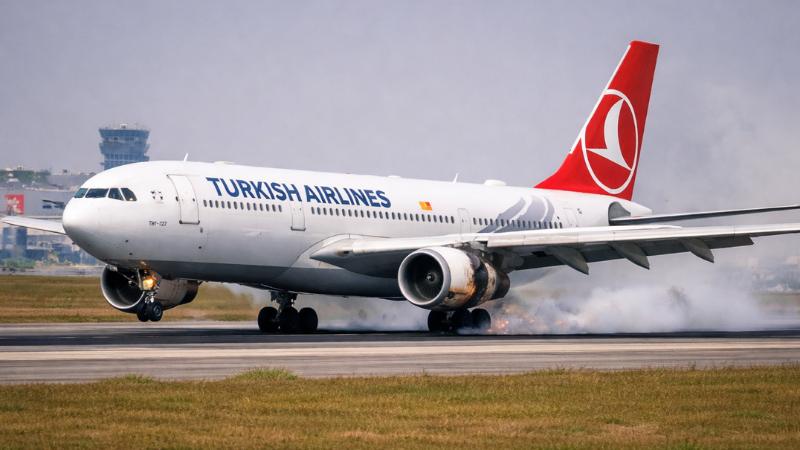
A Turkish Airlines passenger aircraft carrying 236 people made an emergency diversion to Kolkata on Wednesday afternoon after its right engine reportedly caught fire shortly after takeoff from Kathmandu, prompting swift action from flight crew and airport authorities in both Nepal and India. Officials confirmed that all passengers and crew members were safe, and the aircraft landed without injuries, bringing relief to families and aviation authorities.
The Airbus A330-303 wide-body aircraft, operating as flight number THY-727, had departed Tribhuvan International Airport in Kathmandu en route to Istanbul at approximately 1:28 pm local time. Within minutes of takeoff, the cockpit crew detected signs of a malfunction and possible fire in the right engine. According to airport officials in Kathmandu, the issue surfaced roughly four minutes after the aircraft became airborne, triggering standard emergency protocols.
Pilots immediately shut down the affected engine and diverted the aircraft away from the city’s airspace to ensure passenger safety while assessing the situation. The plane was held in the air for around 10 minutes as the crew coordinated with air traffic control and evaluated the condition of the aircraft. Aviation experts note that modern twin-engine aircraft such as the A330 are capable of flying safely on a single engine, which allows pilots to manage emergencies while preparing for a controlled landing.
The aircraft was carrying 225 passengers along with 11 crew members, bringing the total number of people onboard to 236. As a precautionary measure, operations at Tribhuvan International Airport were briefly suspended for about 15 minutes to prioritise the emergency and keep runways clear.
Given its proximity and operational readiness, Netaji Subhash Chandra Bose International Airport in Kolkata was selected for the emergency landing. The captain informed Kolkata air traffic control about the suspected engine fire, following which a full emergency response was activated. Fire tenders, medical teams, and ground staff were deployed along the runway to handle any contingency.
The aircraft landed safely at approximately 2:49 pm local time. After touchdown, it was escorted to a designated bay for inspection while passengers disembarked under supervision. Officials confirmed that no injuries or medical emergencies were reported. The plane remains stationed at Kolkata airport for technical checks, and engineers are examining the right engine and related systems to determine the exact cause of the incident.
For Indian aviation authorities, the episode highlights the importance of regional cooperation and preparedness in handling in-flight emergencies. The seamless coordination between Kathmandu and Kolkata air traffic control ensured that the diversion and landing were executed smoothly, minimising risk and disruption. Airport officials in Kolkata stated that the response teams followed established safety procedures to secure both passengers and airport operations.
Incidents involving engine fire are rare but are treated with utmost seriousness in commercial aviation. Airlines and regulators mandate rigorous inspections before aircraft are cleared to resume service. Turkish Airlines is expected to conduct a detailed technical assessment and submit reports as per international safety standards.
Normal flight operations at Kolkata airport resumed soon after the landing. Passengers were assisted with onward travel arrangements, while the aircraft continues to undergo inspection. Authorities reiterated that the quick response of the pilots and ground teams played a crucial role in ensuring a safe outcome, reinforcing confidence in aviation safety systems across the region.