

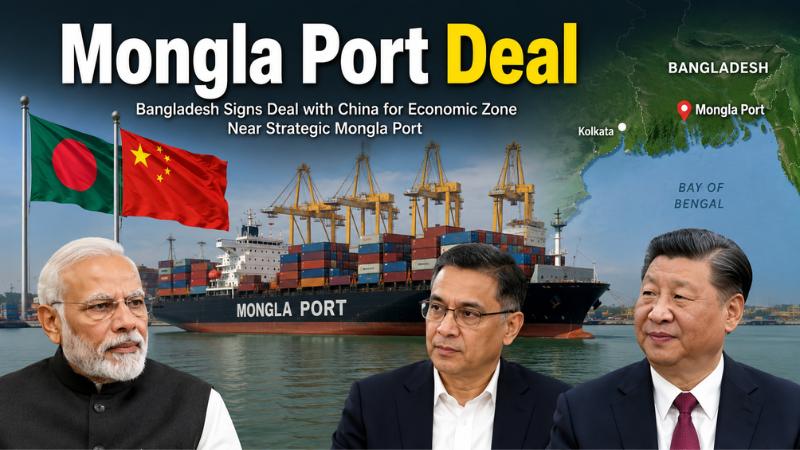
Bangladesh China Mongla Port Deal Raises India’s Bay Of Bengal Concerns
Bangladesh’s decision to move ahead with a China-backed economic zone near Mongla Port has drawn attention in New Delhi, as the project is being developed on land that was earlier linked to an Indian economic zone plan. The move comes at a time when India-Bangladesh ties are facing strain, while China is increasing its economic and strategic engagement with Dhaka.
The agreement involves a Chinese state-owned company developing an economic zone near Mongla Port in Bangladesh’s Bagerhat district. Mongla is Bangladesh’s second-largest seaport after Chittagong and is located close to the Bay of Bengal, making it important not only for trade but also for regional strategy.
Why Mongla Port Matters
Mongla Port is located near the Sundarbans and is around 188 km from Kolkata. Its location gives it strong commercial value for Bangladesh and strategic relevance for India, especially because of its proximity to India’s eastern coastline.
The planned economic zone is expected to come up on around 110 acres of land near the port. According to reports, China plans to support manufacturing units, warehouses, and storage facilities in the area. For Bangladesh, this could help attract investment, improve industrial capacity, and create jobs around a major port corridor.
However, for India, the development is being watched closely because the same land was earlier connected to an Indian economic zone plan. Its shift toward a Chinese-backed project signals a possible change in Dhaka’s infrastructure priorities.
China Steps Into A Strategic Space
China has been steadily expanding its presence in South Asia through infrastructure, trade, and port-related projects. Its involvement in Bangladesh is not new, but the Mongla development adds another important layer to Beijing’s regional footprint.
The timing is also significant. Bangladesh Prime Minister Tarique Rahman chose China for his first foreign visit after taking office, underlining the importance Dhaka is giving to Beijing. During the visit, Bangladesh and China discussed trade, infrastructure, and wider cooperation.
For Bangladesh, closer engagement with China may be seen as a way to secure faster infrastructure support and diversify foreign partnerships. For China, the deal strengthens its influence in the Bay of Bengal, a region where India has long considered itself a key security and economic player.
Why India May Be Concerned
India’s concern is not only about one project. The larger issue is China’s growing presence in a sensitive maritime zone close to India’s eastern coast. The Bay of Bengal is important for India’s trade routes, naval planning, and regional connectivity.
If Chinese companies become more involved in ports, industrial zones, and logistics hubs in Bangladesh, New Delhi may worry about long-term strategic influence. Even if the current Mongla project is officially economic in nature, such infrastructure can shape future trade routes and diplomatic alignments.
India has also invested heavily in connectivity with Bangladesh over the years, including rail, road, energy, and trade links. Losing space in a port-linked project may therefore be seen as a diplomatic setback.
What It Means For Bangladesh
Bangladesh is likely to present the project as an economic decision rather than a strategic shift against India. Dhaka needs investment, industrial growth, and modern port-linked infrastructure. China’s ability to fund and build large projects quickly makes it an attractive partner.
At the same time, Bangladesh cannot ignore India. The two countries share a long border, deep trade links, cultural connections, and security concerns. For Dhaka, the challenge will be to balance ties with both India and China without allowing competition between the two powers to affect its own development goals.
Should Delhi Be Worried?
India has reason to watch the development carefully, but it may not need to see it as an immediate security crisis. The concern is more long-term: China’s economic presence around key ports can gradually turn into a deeper strategic influence.
For New Delhi, the best response may be to rebuild trust with Dhaka, speed up pending connectivity projects, and offer Bangladesh practical economic partnerships. If India wants to remain a preferred partner in its neighbourhood, it will need to compete not just through diplomacy, but through delivery.
The Mongla Port deal shows that Bangladesh is willing to widen its options. For India, the message is clear: influence in the neighbourhood cannot be taken for granted.