Plot
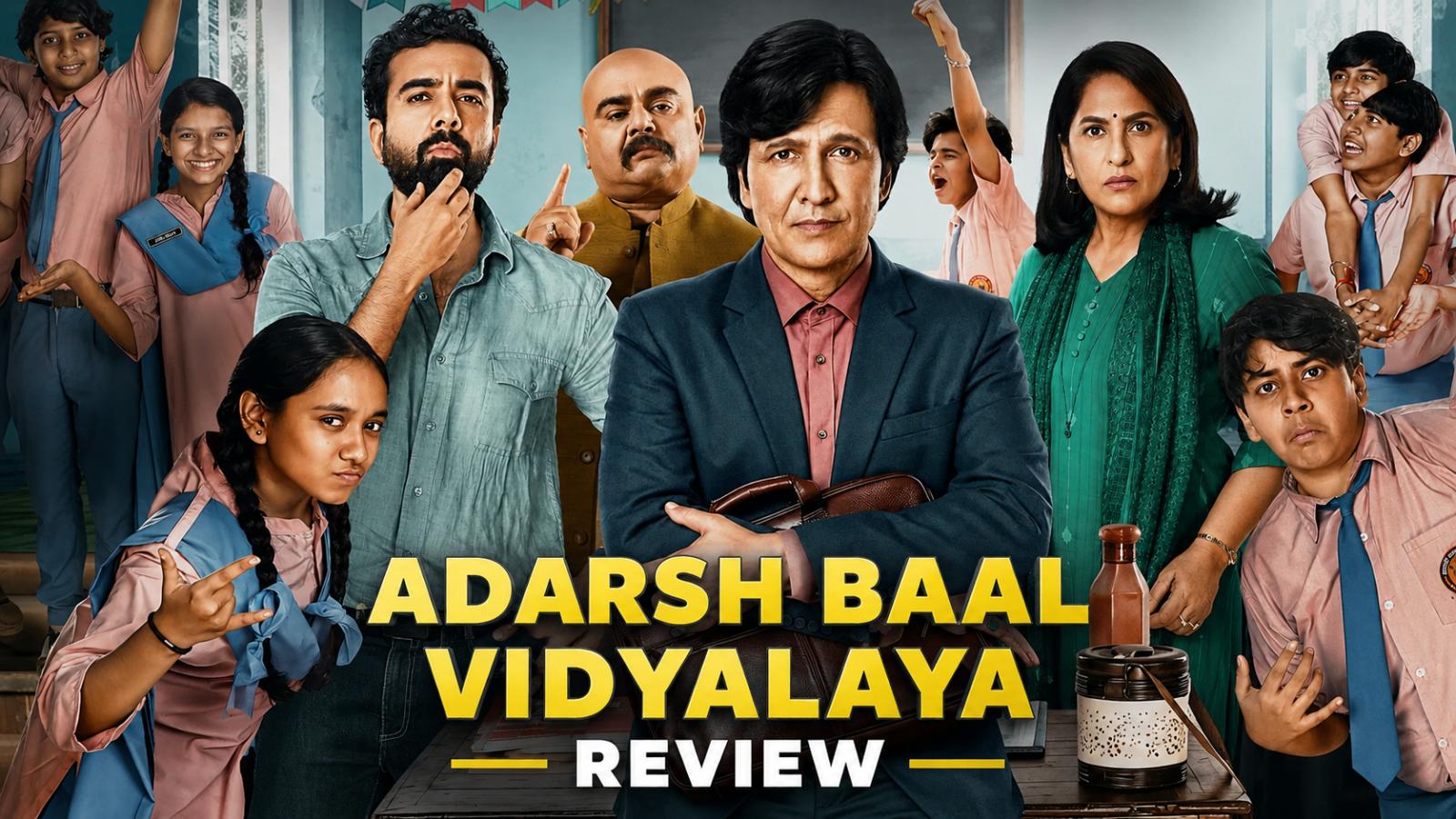
Set in the fictional town of Tinki Toli near Delhi, Adarsh Baal Vidyalaya revolves around a neglected government school that struggles with poor infrastructure, political interference and a lack of resources. The school is led by principal Gyaneshwar Tripathi, a kind-hearted but carefree educator who enjoys spending time with students more than dealing with administrative responsibilities.
His outlook changes after learning about a leadership programme at Cambridge for principals of India's top-performing government schools. Motivated by the dream of taking his supportive wife Sushma abroad, Tripathi begins working to improve the school alongside an unconventional group of teachers. As they face staff shortages and limited resources, they also tackle issues such as examination pressure, child marriage, gender discrimination, sex education, dowry and the obsession with academic marks.
Overview
Created by Biswapati Sarkar and Sameer Saxena under Posham Pa, Adarsh Baal Vidyalaya is a seven-episode comedy-drama that premiered on Prime Video. The series combines humour and heartfelt storytelling to examine the realities of India's government-school system.
Rather than delivering loud social messages, the show uses everyday situations and relatable characters to highlight the importance of compassionate teachers, emotional support and meaningful education beyond examination scores.
Performances
Kay Kay Menon delivers one of his most charming performances as Gyaneshwar Tripathi. He balances humour, laziness, compassion and responsibility with remarkable ease, making the principal instantly relatable. His emotional moments involving former students leave a lasting impact.
Naveen Kasturia shines as counsellor Mukul, bringing warmth and vulnerability to a character dealing with loneliness and parenting challenges. Prasanna Bisht impresses as Kanchan, a mathematics teacher unexpectedly handling physics classes, while Abhimanyu Singh steals several scenes as Hindi teacher Hansraj with his effortless comic timing and emotional depth.
Archana Puran Singh, Prachi Shah and Deven Bhojani provide strong support, making the staff-room dynamics both entertaining and believable.
Technical Aspects
The series succeeds in creating an authentic government-school environment through realistic classrooms, overcrowded spaces and neglected infrastructure. The production design allows the school itself to become a symbol of both systemic failure and hope for change.
The direction remains grounded throughout, avoiding melodrama and relying instead on small victories, natural conversations and believable character development. Although the review material does not identify the cinematographer or other technicians, the overall presentation effectively supports the emotional narrative.
Music
The available material does not identify the composer or soundtrack details. However, the background score remains subtle, allowing conversations and performances to drive the emotional weight.
One memorable classroom sequence uses music creatively to explain menstruation and sex education, making an uncomfortable topic easier for students to understand.
Editing
The seven-episode format gives adequate space to explore multiple teachers, students and social issues. However, the pacing occasionally slows down, with certain episodes lacking sufficient narrative momentum.
A tighter edit could have made the emotional moments even more impactful without affecting the slice-of-life storytelling style.
Positives
- Kay Kay Menon's heartfelt performance
- Strong ensemble cast with natural chemistry
- Authentic portrayal of government schools
- Sensitive handling of social issues
- Organic humour throughout
- Meaningful emotional moments
- Realistic teacher-student relationships
- Strong social commentary without becoming preachy
- Excellent balance of comedy and drama
Negatives
- Slow pacing in several episodes
- Screenplay occasionally loses momentum
- Some important issues lack deeper exploration
- Familiar TVF-style storytelling feels predictable
- Limited dramatic highs
- Slightly longer than necessary
Analysis
Adarsh Baal Vidyalaya stands out because it portrays teachers as ordinary people with flaws, financial struggles and personal responsibilities rather than idealized heroes. Their commitment to students grows through everyday experiences instead of dramatic transformations.
The series thoughtfully questions an education system driven by marks, rankings and statistics while reminding viewers that encouragement and emotional support are equally important. It also addresses gender bias, teacher shortages and social taboos with maturity and sensitivity.
Although the pacing occasionally weakens the narrative, the performances, humour and emotional honesty make the series a rewarding watch. It neither romanticizes government schools nor oversimplifies their challenges, resulting in a grounded and meaningful drama.
Bottomline: Heartfelt Education
Rating: 3.5/5