
- 14 Apr 2026
- 1 posts
Does your morning routine involve a bit too much "hair-math" in the mirror? If you're looking into non-surgical ways to fight male pattern baldness (Androgenetic Alopecia), you’ve likely stumbled upon two heavy hitters: PRP (Platelet-Rich Plasma) and Microneedling.
Separately, they are potent. Together? They might just be the "dynamic duo" your scalp needs. Here is the breakdown of whether PRP microneedling hair actually works for male pattern baldness based on the latest 2026 clinical insights.
What is PRP Microneedling?
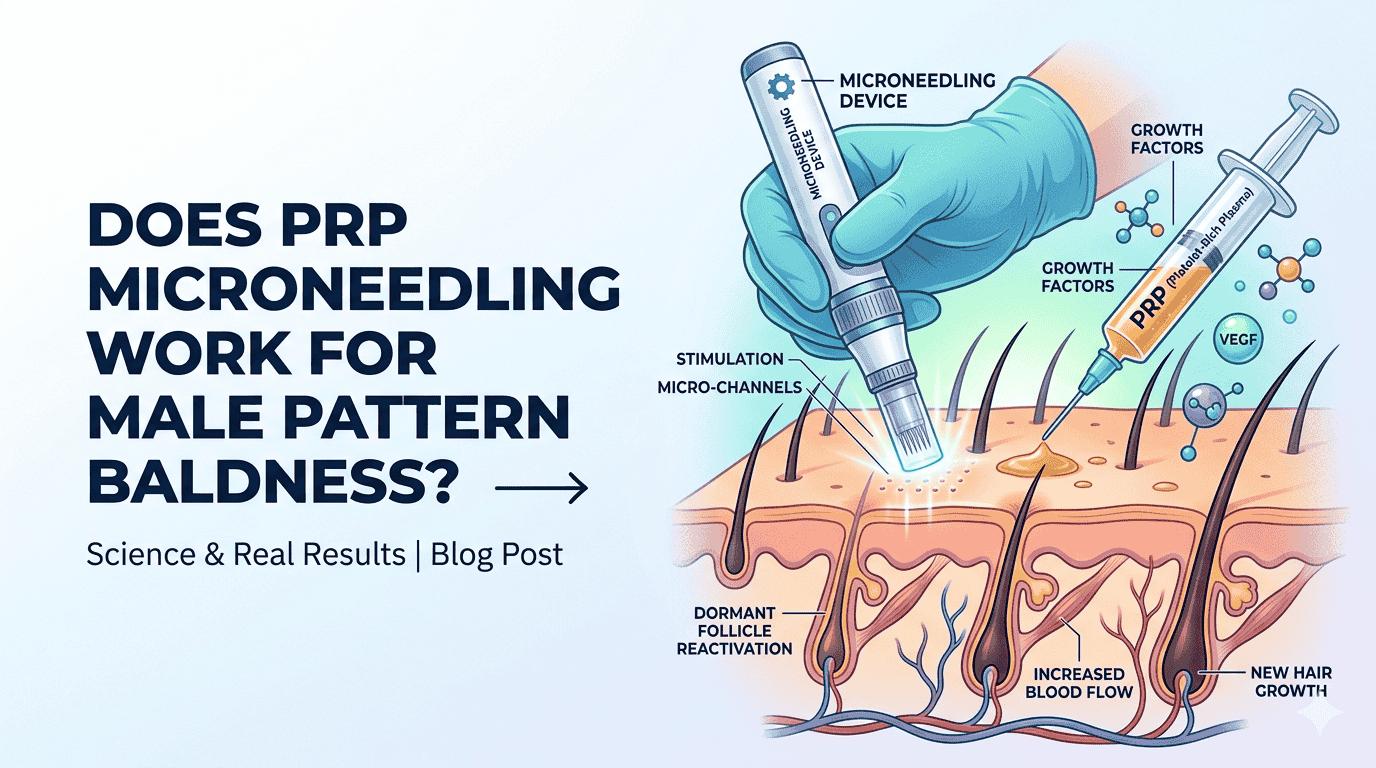
Think of this treatment as a two-step "seek and repair" mission for your hair follicles:
- Microneedling: A device with tiny, medical-grade needles creates thousands of "micro-channels" in your scalp.
This triggers your body’s natural wound-healing response, increasing blood flow and stimulating dormant hair follicles. - PRP (Platelet-Rich Plasma): A small sample of your own blood is drawn, spun in a centrifuge to concentrate the platelets, and then applied to the scalp.
These platelets are packed with growth factors like VEGF and PDGF, which act like "fertilizer" for your hair.
By combining them, the microneedling creates the "tunnels" that allow the PRP to penetrate deeper into the dermis where the hair roots live.
Does It Actually Work? (The Verdict)
Yes. Recent clinical studies (including those from 2025 and 2026) confirm that the combination is significantly more effective than either treatment alone.
The Stats You Care About:
- Increased Density: Research shows a mean increase in hair count by up to 88% in some microneedling-assisted PRP groups compared to baseline.
- Thickness: Studies found that hair diameter (the "thicker feel") improved by over 50% after a standard course of treatment.
- Success Rate: Roughly 70–80% of patients with early-to-moderate hair loss report noticeable improvement after 3-4 sessions.
Pro Tip: While PRP Microneedling is powerful, it works best as an adjunct. Clinical data suggests the best results occur when it’s paired with "gold standard" treatments like Minoxidil or Finasteride.
The Realistic Results Timeline
Hair grows slowly, so patience is your best friend. Here is what a typical journey looks like:
| Timeline | What’s Happening Under the Hood |
| Month 1 | Stabilization: You may notice a significant decrease in daily hair shedding. |
| Months 2–3 | Awakening: Existing hair feels stronger. Fine "baby hairs" may appear in thinning zones. |
| Months 4–6 | Visibility: New growth becomes thick enough to see in photos. Scalp coverage improves. |
| Month 12 | Peak: This is usually when you see the full "after" effect of your initial series. |
Is It Right For You?
Not everyone is a candidate. Here is a quick checklist:
- Works Best For: Men in the early to moderate stages (Norwood Scale II-IV). If a follicle has been "dead" (shiny bald) for years, PRP cannot revive it.
- The "Ouch" Factor: Most clinics use a numbing cream.
It feels like a vibrating, scratchy sensation, but 90% of patients tolerate it easily. - Maintenance: This isn't a "one and done." Expect an initial series of 3–6 sessions (spaced a month apart), followed by a maintenance "touch-up" every 6–12 months.
Summary: The Peer-to-Peer Reality Check
PRP Microneedling isn't a "miracle cure" that will give you a teenager's hairline overnight. However, it is one of the most scientifically backed, non-surgical ways to thickened existing hair and regrow hair in thinning areas.